Tuesday, June 20, 2006

This is what passes for "debate" these days

Last Thursday and Friday, the House of Representatives held a hideous mockery of a debate about the war in Iraq. Patrick Martin's description, including his reporting of the illegal taxpayer-funded "Debate Prep Book" issued by the Pentagon/NSC, is spot-on:
While there were the trappings of debate, with speakers alternating for and against, the procedure was a travesty. The House Republican leadership presented a resolution declaring the Iraq war to be an integral part of a global “war on terror” and condemning any effort to set a withdrawal timetable as a surrender to terrorism. No amendments were permitted, nor were the Democrats allowed to present an alternative resolution for a vote.
The language of the resolution, HR 961, parroting White House propaganda, declared the war in Iraq to be “essential to the security of the American people,” branded as terrorists all Iraqis fighting against the US occupation, hailed the overthrow of Saddam Hussein and the killing of Abu Musab al-Zarqawi, and congratulated the newly installed stooge regime of Prime Minister Nouri al-Maliki.
After rejecting any deadline for withdrawal, the resolution declared, “the United States is committed to the completion of the mission” in Iraq, and “the United States will prevail in the Global War on Terror, the noble struggle to protect freedom from the terrorist adversary.”
...
It is one of the longstanding myths of official American politics that “support” for the troops means endorsing policies that lead to their deaths, while those who urge that US soldiers be moved out of harm’s way are slandered as being “against” the troops. If this patriotic baloney were stripped away, the debate would have seen Republicans demanding thousands, even tens of thousands more American deaths in Iraq, with the Democrats arguing that Moloch could perhaps be satisfied with slightly less blood—or more likely, that the blood should be shed elsewhere, perhaps in Iran or North Korea.
...
One particularly ominous aspect of the House debate was the distribution of a 74-page Iraq Floor Debate Prep Book to several members of Congress. This document was issued by the Pentagon in an unprecedented effort by the military to intervene in a debate within the legislature. After several Democratic congressmen were e-mailed the document, the Pentagon tried to recall it.
...
After one senator complained that the publication of the document violated a legal ban on using government funds for lobbying Congress, the Pentagon revealed that the document had actually been drafted in the Bush White House, by the National Security Council.

It's too bad the Democrats have no coherent opposition strategy. It's too bad they are beholden to the same material interests and ideological prejudices as the Republicans.

IN OTHER NEWS...
Jerry Tucker has a great piece at the Monthly Review Zine concerning "liberal orthodoxy" and the way in which mainstream liberals have given up on the working class, exemplified by George McGovern gently lecturing workers that they need to be satisfied with less.

Sunday, June 18, 2006

Silence deafening on Churchill

I have reprinted Tom Mayer's defense of Churchill on three different forums and no one has said a word about it, for or against. Mayer can't get any mainstream media to print that defense, either.

Over at Swan's Commentary, Gilles d'Aymery feels the silence too:
As to Ward Churchill, the silence is deafening. The so-called Standing Committee on Research Misconduct of the University of Colorado at Boulder recently issued a politically motivated 124-page report accusing professor Churchill of "academic misconduct" and calling for sanctions, perhaps temporarily, or even excluding him from the university. Professor of sociology Tom Mayer deconstructed the report in a 1900-word article that he sent to local papers in Boulder to no avail. They all rejected the article because "it was too long." Nineteen hundred words to criticize a 124-page report are considered too long by the local guard dogs of the orthodoxy. The national press simply ignored the issue altogether -- or maybe they covered it in tiny snippets buried in the bowels of the papers. One can easily imagine a Van Gelder treatment of the news: "Controversial professor is charged with academic misconduct: Ward Churchill, a professor of ethnic studies at the U. of Colorado who called the 9/11 victims at the World Trade Center 'technocrats' and 'little Eichmanns,' and blamed Americans for what he called the 'genocide' of the Indian nations, was accused of gross academic misconduct by the university Standing Committee on Research Misconduct. The committee recommends sanctions that may include his expulsion from the university."

What's troubling is that Mayer's response takes up a number of issues with the Standing Committee and the original report, on-point: The political motivation of the original investigation, the alleged improprieties and violations of protocol, the inconsistent punishment compared to other scholars guilty of the same things, the overstatement of "misconduct" when really, there's little more than allegations of factual innacuracies and lots of difference of opinion, and so on.

Yet nobody is saying anything--well, except the people who would have fired Churchill for his 9/11 statements without even pretending to look for other reasons.

Churchill's latest response can be found here.

Tuesday, June 13, 2006

Colorado University Standing Committee Recommends Ward Churchill be Fired

Today the University of Colorado's Standing Committee on Research Misconduct voted 6 to 3 to fire Ward Churchill--terminate his employment completely. This is a substantially stronger result than was even recommended by the review panel. The recommendation will now go to the CU administration for their final decision.

Something isn't right about this. The more I read both sides of the story, the more I strongly suspect two things:

1. The investigation itself and the decision of the standing committee were politically motivated.

2. The facts in the case are problematic and in dispute:

a. the strongest charge seems to be the plagiarism, but as Tom Mayer pointed out in his powerful defense of Churchill, even Lawrence Tribe committed more egregious plagiarism and wasn't fired. Churchill has written elaborate responses to each plagiarism charge. At worst, there might be a slight preponderance of evidence in favor of plagiarism or a risk of plagiarism; it is far from clear that they were able to prove intent to plagiarize, which is probably why they recommended suspension rather than termination.

b. Churchill may have been factually incorrect about some of his conclusions and claims, but there was no INTENT to deceive proven by the review. At worst it seems that the committee concluded he had provided insufficient evidence to back up his historical claims. Since when does this constitute research MISCONDUCT as opposed to simply "bad research?"

c. CU has not, to my knowledge, responded to Churchill's allegation that the review process violated university rules concerning confidentiality. He wrote: "Under University rules, this report was part of a confidential personnel process. The fact that the committee convened a press conference to announce its findings and University officials immediately distributed the full report is but one indication of their willingness to violate my rights, as well as their own rules, in order to chill my speech and discredit my scholarship." Churchill cited many other procedural improprieties in his defense as well.

d. Again, there were no professors of Ethnic Studies on the review committee. I realize I've been over this before with some people, but my only argument here is that the conclusions of the review would have seemed much more fair, impartial, and informed if the committee would have selected any one of the HUNDREDS of qualified ES professors in North America to be on the commitee, or at least, for god's sake, to offer expert testimony in the review process.

I don't particularly like Ward Churchill's style of political engagement. I think he's set back some causes I support. But this whole process smells more and more like a railroading to me, and I was wrong when I didn't say so before.

I'll Cry 9 Billion Tears

Remember that $9 billion in Iraq reconstruction money that went missing and was never accounted for?

Regeneration Man, posting on Daily Kos, informs us that Bush used one of his notorious "signing statements" to block an investigation into the money, on the grounds of national security.

Sunday, June 11, 2006

Pin the Tail on Zarqawi

The "Zarqawi" in the video does not speak Arabic with a Jordanian accent. His legs seem pretty normal. And crucially, he wears a golden ring, which for an authentic jihadi would be the ultimate affront. On the same day, June 22, of the release of the Kim video, "Zarqawi" also released a statement - but with a different voice, saying he was determined to "ignite a civil war between Sunnis and Shi'ites"..."Zarqawi's" voice can be heard for a few seconds - but the audio was taken from another tape released after Abu Ghraib when he was threatening Allawi's government. (From "Zarqawi - Bush's man for all seasons," Asia Times, October 15, 2004)

It seemed puzzling, too, given the destruction and the condition of the other five bodies, that Zarqawi's head and upper body - shown on televisions across the world - could have remained largely intact. (From "Riddle of how Zarqawi died," Sydney Morning Herald, June 12, 2006)

I have consistently stated that I consider the beliefs and tactics of Islamo-Fascists (call them "terrorists," "extremists," or what you will) to be morally unacceptable, politically bankrupt and counterproductive, based on a backward and hateful mentality concerning human rights and ethical responsibility, and so on and so on. Socialists should not, and need not, take the side of Al Qaeda, Baathism, or fundamentalism of any kind in current world events. I have no sympathy for Abu Musab al-Zarqawi. But part of the problem is that we don't know who he was, and it's not altogether clear that he wasn't at least partially constructed by the United States; at the very least, his public meaning, the "text" of him, was very much a Western construct, created and perpetuated to justify the continued U.S. occupation.

(On the empirical question, it's important to remember that Zarqawi's entire existence in the occupation has been tainted with questions of whether he exists at all, particularly in the form and function attributed to him; fake letters, questions of whether he actually died years ago, and questions of exactly what role he really played in sectarian violence.)

At the very least, as Matthew Yglesias succinctly put it, "the whole Zarqawi phenomenon" was "the product of a bizarre collaboration between a Bush administration eager to identify an enemy in Iraq and a terrorist eager to overstate his own importance." Yglesias even goes so far as to call Zarqawi's death "apparent," which is appropriate, given that so many activities attributed to him were equally "apparent."

(For those conservatives and moderates out there who consider this kind of talk the hight of leftist reactionism and irresponsibility, remember that the U.S. pays foreign media to run fake stories. I'm as modernist as they come, but it's no exaggeration to say we don't know what's real over there!)

Zarqawi's "sociological existence", was also confirmed rhetorically by the mainstream U.S. media's response to Zarqawi's death. Response was jovial; orgasmic. I'll let Kate Randall and Barry Grey explain:
The exultation in the Islamist terrorist’s demise, replete with gruesome photos of the corpse plastered across newspapers and displayed on TV screens, takes on an almost ritualistic character...
“Gotcha!” was the front-page headline on Friday’s New York Post tabloid, atop a full-page photo of the dead man’s scarred face lying in a pool a blood. The newspaper’s inside headline read: “Evil Zarqawi Blown to Hell.”
The New York Daily News front page exclaimed “PICTURE PERFECT! Al Qaeda Terror Boss Blown Right to Hell.” Below was US soldier holding a large framed copy of the same photo...
This spectacle bespeaks both the mindset of the American ruling elite, and what it seeks to inculcate among the public at large. Terms that come to mind in regard to the outlook of the ruling establishment are “primitive,” “backward” and “self-delusionary.” It retains an almost childish belief that it can somehow extricate itself from the disaster it has created for itself in Iraq if only it can kill another 5,000, 10,000 or 100,000 people.
At the same time, it is driven by a need to brutalize and degrade public consciousness...The more obnoxious and heavy-handed their propaganda, the less real and lasting is its impact.
Most Americans...do not really believe that Zarqawi was the towering figure described by the government and the media. And in this their instincts are correct. His exploits, in fact, both real and apocryphal, played a negligible role in the growth of Iraqi resistance to the American invasion and military occupation. Any impact he did have was destructive of the resistance, since his deeply reactionary aim was to incite sectarian warfare between the Shiite majority and the Sunni minority.
Zarqawi was far more significant for the function he served as the latest devil incarnate conjured up by the US government and media to somehow justify the war. Unable to provide a coherent rationale for the war, the political establishment, Democratic as well as Republican, is perpetually looking to find—or manufacture—a new symbol of evil they can use to frighten and disorient the public.
Zarqawi had barely been dead a day when Bush administration and military officials began floating reports about his replacement. It appears at present that the new devil will be Abu al-Masri, reputed to be an Eqyptian-born associate of Zarqawi. The US Central Command already has a $50,000 bounty on al-Masri’s head.

There's more, of course. Michael Reagan joked on his radio show about Zarqawi "looking for the virgins" in heaven. Jay Leno told all kinds of jokes about the death. Such celebration deeply disturbed my friend Josh House, who seems to wish, not unreasonably, that we treat this alleged clash of civilizations as a struggle requiring the winning side to be genuinely ethical, genuinely above bloodlust and making light of any death and suffering whatsoever. He certainly has a point.

It's perfectly fine to feel satisfaction at the death of someone who kills other people, innocent people. It's equally fine, rational really, to take that satisfaction with a grain of salt, knowing that his death probably won't make things any "better," that is, probably won't contribute to the long-term stability of the communities of suffering, alienated human beings who have become pawns in the spats of the powerful. It's also perfectly rational, and perhaps morally and intellectually mandatory, to question the timing of all of this, to remember that the past several weeks have been very bad for the U.S. propaganda front, what with allegations of unprecedented civilian massacres and further revelations of corrupt wartime administration. One sees that the Zarqawi ritual was performed with exacting precision--the performance in Iraq, the predictable celebratory reaction back in the U.S.

Zarqawi's apparent life and apparent death are a powerful metaphor for the question of who gets to control reality; ownership of the means of reality-production, if you will...The important question is how we can produce the kind of reality that no longer rewards the commodification of life, and the ritualistic celebration of death.

Wednesday, June 07, 2006

Kong

Did anyone else find Peter Jackson's King Kong beautiful and profoundly sad?

Some of that certainly had to do with a very good score by James Newton Howard, David Long, and Mel Wesson.

But I won't even attempt to interpret or read deeper meaning into the movie. It was simply beautiful, and sad.

Monday, June 05, 2006

"Your troubles will cease and fortune will smile upon you"

Over the weekend Andrea and I watched Stay, written by David Benioff and directed by Marc Forster. Actually, I watched it alone Saturday night after the kids went to bed, and then Ann and I watched it Sunday night. It's a creepy, thought-provoking, beautifully constructed film about the dream-world that exists between life and death. It's the thinking person's Sixth Sense. Rent it. Watch it. Think about it.

Saturday, June 03, 2006

The Failed Invasion of Iraq

Jason Zengerle at The Plank points out that Bill O’Reilly, of all people, has called the Iraq War not only a failure, but an avoidable failure. Zengerle draws a parallel between O’Reilly’s pronouncement and Walter Cronkite’s similar declaration during Vietnam:
After Walter Cronkite pronounced Vietnam a stalemate, LBJ famously told his aides, "If I've lost Cronkite, I've lost middle America."

The recent wave of unpleasant stories of massacres, alleged massacres, and casualties-by-mistake (including children) in Iraq, combined with Bush’s historically low approval ratings and the brink of some serious gains for the Democrats in November (despite their fundamental lack of “vision” and their reliance on the same corporate influence and cynical attitudes toward their constituents), reveal two important things about current public consciousness: First, the American public is perfectly capable of respecting and being concerned for U.S. troops, even in the midst of a near-universal consensus that this war was and is horribly, horribly wrong. This first fact is especially important because the war-borgs have traditionally relied on conflating “respect for our soldiers” with unquestioning support for “the mission.” There is nothing to suggest that this conflation is the least bit successful anymore, and considerable evidence that it is counterproductive. It’s irrefutably clear that we can love, honor, respect and even admire the heroism of rank-and-file military personnel, and even contextualize (if not forgive) criminal brutalities in their midst, while understanding that the fundamental blame for this fiasco rests with the ruling class (including opportunistic Democrats).

The second fact about public consciousness is that the Bush administration’s arrogance and incompetence have not only destroyed what little shallow support existed for this war, but also the support for any future military adventures, including those ostensibly required for fighting the eternal, unending War on Terror. Skepticism, mistrust, and contempt—which the ever-shrinking right translates as treason, are the new order of the day. We have entered a new period of rejectionist thinking where military deployment is concerned. And without the usual rhetorical tricks up their sleeves, the war-borgs will have a tough time remedying this. The space has at least opened up for alternative ways of thinking about global crises, mass brutalities, enemies and allies, and inequalities of power and economics. Whether such alternative visions will result in any coherent alternatives remains to be seen, but we should be neither ashamed nor embarrassed if we derive satisfaction from seeing the Bush administration collapse under the weight of its own cynicism and stupidity. We just have to keep in mind that such justified satisfaction is not enough to make the world a better place.

Those who lament that we could have done it differently, that there was a “winnable” way to invade, kill a bunch of evil people, and build a new country, are missing the point. The belief that some new kind of U.S. leaders could be elected, in the context of the present era, who could exercise military power responsibly, ethically, and competently, is at least as utopian as any of the allegedly deranged pipe-dreams of the peace movement.

One more thing: Those who continue to insist that "everyone" was wrong about Iraq's WMDs, those who continue to insist on giving Bush the benefit of the doubt, and maintaining that he was merely misled by other people's bad intelligence, need to first read and attempt to refute this fine article published by FAIR.


And this is the view of geopolitics from the ground:

Thursday, May 11, 2006

Some recent photos

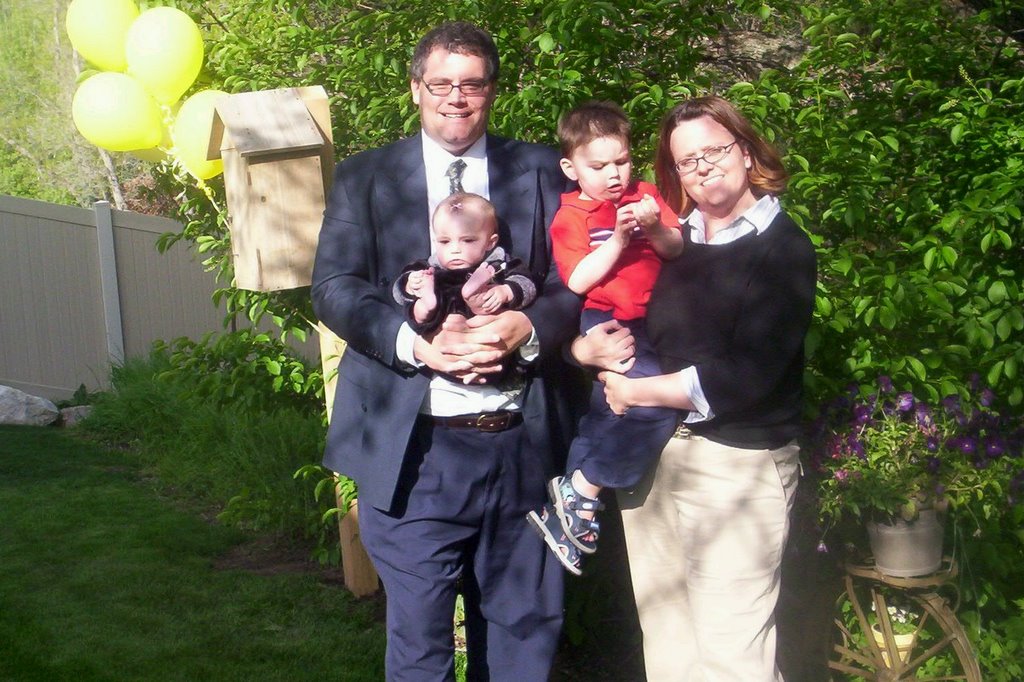
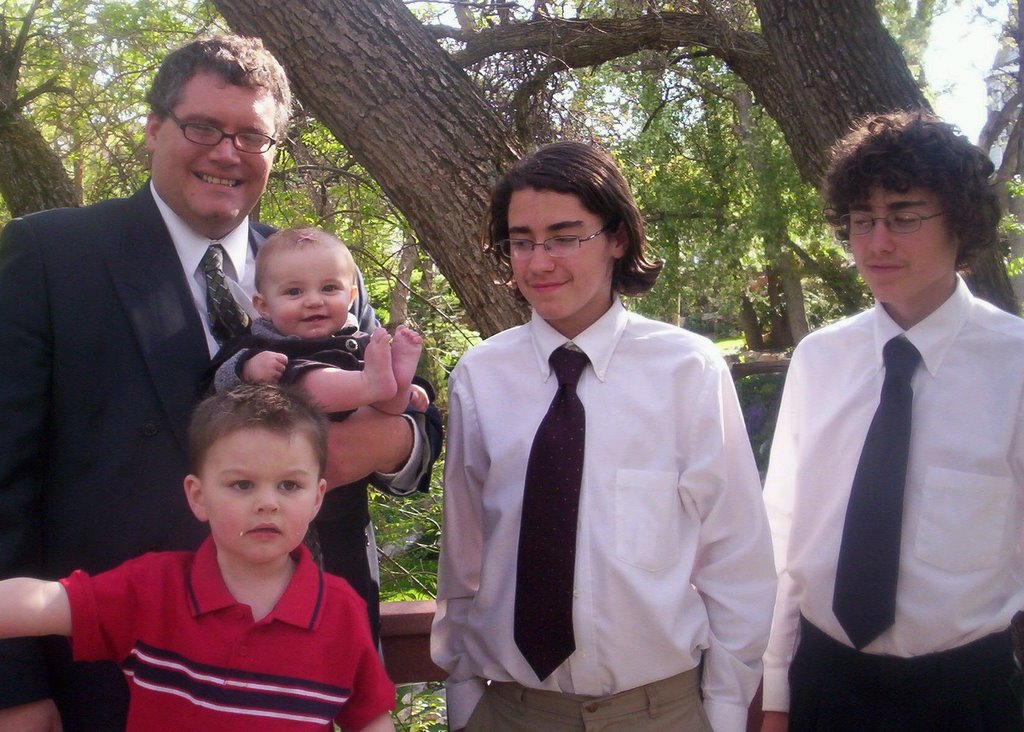
On the day of my father's funeral, we took a lot of pictures of the family. The first picture below is of Ann, Andrew, Abigail and me. The second one is of all my kids, Andrew, Abby, Stephen, Levi, and of course me.


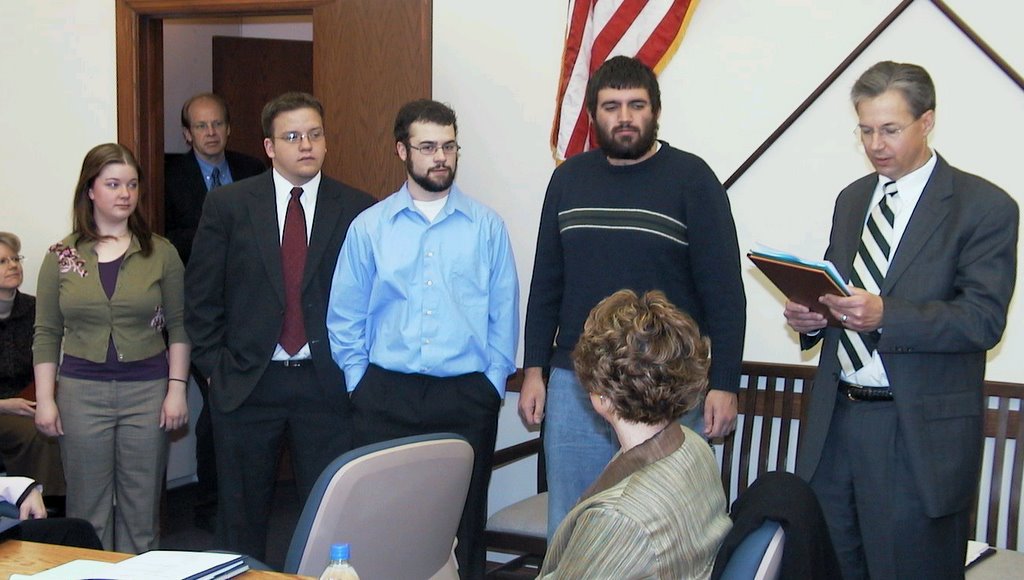
Last week, the UW Board of Trustees honored Sara DeGroot, Chris Crowe, Brian DeLong and David Braz for their performances on the debate team this year. Although Braz looks like a serial killer in this picture, I'm still proud of him:

Sunday, May 07, 2006

Eulogy for my Father


Thomas Alvah Stannard, July 7, 1932-April 29, 2006

Thank you all for coming today to celebrate the life of Tom Stannard.

My father was the first intellectual I ever knew. The definition of “intellectual” is “of or associated with or requiring the use of the mind,” and “a person who uses their mind creatively.” Also, it’s a word that’s been turned into a kind of insult for quite some time now. If you’re an “intellectual” that must mean you don’t believe in a higher power; it must mean you’re a subversive, you aren’t patriotic, or, above all, you think you’re better than everybody else. My father was none of these. He was spiritual. He was patriotic (although, as my father proved, being patriotic doesn’t mean agreeing with everything your government does). He certainly did not think he was better than anyone else. Tom Stannard devoted the better part of his life, in fact, to giving the gift of intellect to those members of society most likely to be written off by the elite: children, often poor children, children of immigrants, sometimes children of illegal immigrants. And in this time of national conversation over who is an “American” and who is entitled to social goods, it seems fitting to remember that my father, a teacher, may have had his opinions about national immigration policy, but as with all his political opinions, they were checked at his classroom door. When he walked into his class, the only thing he cared about was giving his students the gift of the mind—the invitation to a contemplative, intellectual life—which he believed was available to each and every human being if they wanted it. He did not believe only white, English-speaking people could receive such gifts, nor did he believe that you had to be wealthy, or have wealthy parents, to be able to understand and appreciate Shakespeare, Aristophanes, or Gabriel Garcia Marquez. Tom Stannard was a complex, sometimes paradoxical person in his life, but a very simple, single-minded person in the classroom: He wanted to take each set of kids he taught—white, Black, Asian, Latino, poor, or middle class—and help them become intellectuals. Help them appreciate books. Help them appreciate the ability of the mind, and the ability of humanity’s vast body of literature, to address the complex problems of everyday life and civilization.

My father gave me several unforgettable gifts. Two of them came in the form of books: A long time ago, he gave me the complete works of William Shakespeare. Dad was something of a Shakespeare-phile. One of the reasons he was so fascinated by Shakespeare was that “the Bard” was not a nobleman, not a university doctor, but a common, middle-class writer who ended up being the preeminent wordsmith of the English language. In fact, every once in a while you hear some cockeyed theory or another about how Shakespeare couldn’t have written as well as he did; it must have been some nobleman writing under a pseudonym. Dad and I talked about those theories once, and he answered them with that characteristic, unforgettable, sarcastic Tom Stannard disgust. You all know the kind of disgust I am talking about.

Because, as I said, Dad believed that the gifts of the mind were available to everyone. Shakespeare’s genius validated my father’s belief that no one was really better than anyone else. “We are all frail,” says Angelo in “Measure for Measure,” “frail” meaning prone to sin rather than ill of health. Or, following Antipholus in “The Comedy of Errors,” we are all merely drops of water, who find our significance in bonding with others:

“I to the world am like a drop of water,
That in the ocean seeks another drop,
Who, falling there to find his fellow forth
(Unseen, inquisitive), confounds himself.”


The second great gift my Dad gave me, more recently, was a complete collection of Arthur Connon Doyle’s “Sherlock Holmes” stories. Dad was a Sherlock Holmes fanatic and even when I was very small he would sit me in front of the television when a Holmes movie was on. For Sherlock Holmes, grand truths were found in small details, and no client’s story or personal tragedy was beneath the great detective’s concern. Those will always be virtues I associate with my father. Now, I have become a Holmes fan myself, and an image of my Dad is in every encounter I have with the great detective: Dad peers over my shoulder as I read, and his unforgettable impersonation of Holmes is the voice I hear when the great detective speaks. I can hear his voice when Doyle writes in “The Red-Headed League,” “My life is spent in one long effort to escape from the commonplace of existence.” And, when Holmes, speaking of learning in “The Adventure of the Red Circle,” says “Education never ends, Watson. It is a series of lessons, with the greatest for the last.”

The third great gift I received from my Dad was to watch him teach, to sit in his classroom and see him work his magic with junior high students. I remember telling someone about my Dad and they said with awe, “junior high students! How did he do it?” I wish I knew. For a year, between jobs, I was a substitute teacher and I dreaded going to the middle schools. But Dad couldn’t have been any more comfortable. When I watched him, he held the class in rapt attention discussing metaphors, how to make imagery concrete, how to give words multiple meanings, how to make language beautiful. Tom Stannard believed in making words beautiful, and furthermore believed in sharing those gifts with a section of the population we would rather forget existed: junior high students in general, and in Dad’s career, economically and culturally marginalized students. Children of immigrants. My father, who was cynical about all politics, fought against the Immigration and Naturalization Service when they attempted to remove “illegal” children from his classroom. In his classroom, no one was “illegal.” He designed and implemented after-school programs for “latch-key” kids. He oversaw gifted and talented programs for students who did not have the economic and cultural privileges to access such programs as birthrights. This was his life, his greatest pride, the epitome of everything he stood for.

I am a teacher. I will spend my life trying to be half the teacher my father was.

So today I am celebrating the life of Tom Stannard, intellectual. But not the kind of intellectual who sits in an ivory tower and plays analytical games. Rather, a human being of modest background who believes the contemplative life is available to all human beings. It’s a lesson those of us in the education profession need to hear again and again. My father, who lived to tear down the hubris and self-righteousness of hypocrites everywhere, reserved his most poisonous venom for those who would arbitrarily place some humans on pedestals higher than others. His was a labor of love, and in “A Midsummer Night’s Dream,” Helena declares:

“Love can transpose to form and dignity.
Love looks not with the eyes, but with the mind.”


Thank you, Dad, for giving me the gift of a mind.

Friday, April 28, 2006

Deliberation, Democracy and Debate

Deliberation, Debate, and Democracy in the Academy and Beyond

By Matt Stannard, Department of Communication and Journalism, University of Wyoming
Spring 2006 Faculty Senate Speaker Series Speech, April 18, 2006, Laramie Wyoming

I: Introduction: Deliberation and Debate as the Democratization of Truth

Within the Academy, the value of deliberation, and the importance of broad participation, is a tentatively accepted truth. Outside the Academy, pundits marvel and jeer at our obsession with "inclusion," an obsession they equate (or equivocate) with "political correctness" and "liberal guilt." Within the Academy, students, instructors, and thankfully sometimes even staff, push and politicize deliberation and inclusion. We mostly consider broad debate, public demonstrations, and the airing of collective opinions the mark of a mature and healthy institution. Outside the Academy, pundits shake their heads and warn parents that today’s colleges are hotbeds of radicalism. Our codes of academic freedom, the public pronouncements of our often-beleaguered administrators, our very syllabi, are full of phrases like "open debate," "responsible communication," and "marketplace of ideas." Outside the Academy, these phrases are seen as alternatively quaint and sinister.

But the Academy is not only under attack from "outsiders," and not merely because the post-September 11 world has given the nod to sterile and commodified forms of patriotic communication and safe, symbolic dissent. Both inside and outside college life, the value of discussion is increasingly under attack, under sabotage, sometimes unintentionally, sometimes violently, and the attackers are often not recognizable as such. We cower away from religious fanatics because we know they refuse to entertain the possibility of their incorrectness, but we fail to see our own failure to embrace the possibilities of our own incorrectness. We label other points of view "ideological" from vantage points we assume to be free of ideology, or we excuse our narrow-mindedness by telling ourselves that "ideology is inevitable." Part of this weakening of our commitment to open debate is our recent, seemingly liberating embrace of personal conviction over public deliberation, the self-comfort of personal narrative over the clumsy, awkward, and fallible attempt to forge consensus across the lines of identity and politics. The fetishization of personal conviction is no less threatening to the public forum than violent authoritarianism—both seek to render disagreement impossible, close off deliberation, and take us closer towards eventual, unnatural silence.

The alternative I would offer today is rooted in the communicative ethics of deliberation, and its academic embodiment is the practice of debate—both in competitive and non-competitive formats: debate as rule-based cooperative truth-generation. Deliberative ethics, following the communication theories of Jurgen Habermas, and the ethical theories of Emmanuel Levinas, among others, are ethics concerning how we collectively construct "truth" itself. What I am speaking of might be called the democratization of truth. Such talk is immensely unpopular on both sides of the ideological spectrum.

From one side, there is distrust of "democratization" and its accompanying "mob rule." Immediately, the thought that ontologies can be democratized raises the eyebrows of absolutists everywhere because who, really, would want truth left up to an angry, uninformed mob? The idea that our truth-systems can be democratized sounds suspiciously like relativism, radical subjectivism, and possibly even nihilism.

From another side, there is distrust of the term "truth," the assumption that it’s going to sound problematic no matter whether it has a big T or a little t. The collectivism of "democratized truth" threatens to assert a universality that has been out of fashion among the academic left for some time. After all, Lyotard, Baudrillard, and South Park have all taught us that there are a bunch of little stories, not one Grand Narrative—let alone one which asserts Grand Truth.

But both the academic right, with its stuffy, ontological authoritarianism, and the academic left, obsessed with identity politics and microdiscursive revolutions, are barking up the wrong tree where communicative ethics are concerned. This democratic system of thought, which I’ve come to discuss with you today, is grounded not in grand systems or deconstructive criticism, although both extremes are welcome to make their case in a democratic forum. Discursive democracy is, instead, grounded in the most primary of ethical concerns for the people around us. As such, it demands a listening that is wholly unfamiliar to the ideological battles taking place inside of academia, as well as among talking media heads, Clear Channel Communications, Congress, or campus demonstrations full of pie-throwing and shout-downs. What Habermas and others have in mind is a kind of communication where each affected person becomes a participant and co-creator of conclusions relevant to their lives; a communicative version of Marx’s dictum: from each according to ability, to each according to need.

Discursive democracy is both a way of thinking about problems—intellectual and otherwise—and a political rallying-cry that promises to turn ideological blinders into conversational openings. It’s a method of rhetorical and communication analysis, but also a tool for immediate social analysis with the potential to involve people from all walks of life.

I will ultimately conclude that deliberative ethics are a tool of social survival, a check against what Habermas calls the "colonization of the life-world," a condition we may already be in, that risks both small and big apocalypses with every passing day. But on the brighter side, I’ll also say a good deal about communication and ethics, and about how knowing a few basic things about communication has the potential to make us not only faithfully good communicators, but also to make us enjoy the existence of other people. After all, we owe them our very lives.

II: The Inevitable and Constitutive Others: Jurgen Habermas and Emmanuel Levinas on Communication

Communication theory begins with the axiom that other people are both inevitable and constitutive: Inevitable, because our very existence and identities are predicated on the existence of alterity, or other-ness, and constitutive because our personalities, thoughts, and projects are constructed by those other people and things. Because this is a foundational truth of communication theory, and not an unpleasant side-observation, the study of communication has always contained a subversive element that has served as a check against both the imperialism of metaphysics, and the nihilism of skepticism.

According to Lithuanian philosopher Emmanuel Levinas, the original sin of Western philosophy is the assertion that the self is prior to the other, and the extension of that sin is the belief that ontology, the study of being, and metaphysics, the assertion of overarching systemic reality, are prior to our ethical relations with other people. Most traditional thinkers believe that we must first understand the nature of existence before we figure out how to respond to one another. Levinas disagrees. He says that the very formulations of ontologies and metaphysics are ethical acts, designed as responses to our encounters with other people. Hence, the ethical encounter is prior to ontology, and indeed all philosophy. Western philosophy has hitherto placed the self at the starting point: the subject is prior to the object. The "I" established by the Cartesian cogito is the ‘starting point’ for any kind of knowledge of the external world.

But instead, the other is actually prior to the self. Alterity, exteriority, is prior to one's construction of an interior self. Without alterity, we would not know that we exist. We have no sense of touch until we touch something, no sense of sight until we see something, no thoughts until things confront us to be thought on.

Ethically, the priority of the other over the self means that responsibility is inescapable. For Levinas, we're always responding, always responsible. A starving person asks you for food. There are a variety of ways to respond: You can feed that person; you can lecture them on the link between capitalism and poverty; you can lecture them on the importance of personal responsibility; you can lecture them on the Malthusian argument about overpopulation; or you can turn around and walk away from them as they starve to death. But all of these things are responses; it's impossible not to respond. You are linked to the fate of the other by virtue of the fact that the other makes a demand or request of you.

Levinas also believes that most "theories" ultimately fail because they serve as ways of attempting to avoid, rather than appropriately respond to, the ethical responsibility that comes from that basic encounter with the other. For example, utilitarianism means that some people (the minority) might get hurt, but we comfort ourselves by saying "well, within my framework, I still did the right thing." Likewise, deontology might hurt a lot of people, but we comfort ourselves by saying "well, we must do what is right even if people get hurt," etc. The orthodox Marxist reduces human suffering to historical materialism. The capitalist reduces it to analytic economic terms and an atomistic conception of personal freedom. The theologian reduces it to God's will and (perhaps) some kind of grand scheme of theodicy. And so on. All of these things are done with the sincere desire to "understand" the other, but they end up reducing the other-ness of the other to a comprehensive catalogue of a system. However inevitable or sometimes useful it may be, all systemic thinking fails at one point or another, because the other is infinite, and eludes totalization.

But the one "universal" condition Levinas does celebrate is that of communication. Shared understanding always fails at some degree, but the attempt to share understanding (and the concomitant attempt to manipulate and persuade) is inevitable. There are distinct ethical differences among various types of communication—for Levinas, a distinction (of which contemporary communication scholars should take note) between "the saying," communication which presupposes an ethical openness to the other, and "the said," which describes the closed, systemic pronouncement that the conversation is over.

For our purposes, deliberative ethics strives to keep the "saying" alive. But it also takes the step of striving to open up the "said" to democratic, participatory construction (which really means stripping the "said" of its authoritative permanence). This is where we enter the world of German philosopher Jurgen Habermas, and also where we learn something we may not have suspected before about skepticism and relativism.

Where Levinas and his family were victims of Nazism, Habermas was pulled into the Hitler Youth. Both thinkers emerged from the nightmare of Nazism deeply concerned about justification: Levinas with the ethical failure of metaphysics, Habermas with the absolute necessity of communicative rationality. If it sounds like these two concerns are in tension with one another, that’s understandable, because we have been taught to see absolutism and relativism as opposites. For Habermas, however, absolutism and relativism are two sides of the same coin: Both represent a failure to live up to the norm of communicative rationality. In the case of absolutism, communication is cut off in favor of authoritative pronouncements. In the case of relativism, rationality is abandoned, the proverbial baby thrown out with the bathwater. The Nazis were absolutists, but this absolutism rested on an abandonment of rational processes. In a world where we cannot arrive at truth through rational consensus, we are left with the will to power as the only possible determinant.

In modern society, that will to power is expressed as non-human, non-intentional forces. Habermas refers to this phenomenon as the "system" (impersonal forces) colonizing the "lifeworld" (shared, personal, intentional understanding between autonomous persons). Social life gradually depends more and more on what we perceive to be impersonal, systemic forces. Truth is imposed from above, disguised as necessity. Human beings lose themselves to the technologization and impersonal administration of a small elite. The chance of injustices being interrupted by disruptive intervention, protest, or revolution melts away.

In response, Habermas proposes a process of attempting to arrive at rational consensus through participatory deliberation. Although he is not the first thinker to put forward a consensus-based theory of truth (others who have done so include Charles Sanders Peirce and Thomas Kuhn), Habermas’s emphasis on the free participation of those affected by the establishment of truths makes his philosophy radically ethical in a manner which compliments Levinas’s deference to the other. "Communicative action" is Habermas’s term for the shared process of giving and criticizing reasons for holding or rejecting particular claims. In this deliberative process, all affected parties should have their say; all should be able to accept the reasons and the consequences of decisions, everyone must be allowed to introduce any argument they desire, and there is an expectation that everyone listen to and consider the arguments of others.

It is important to remember that Habermas is resisting both absolutism and relativism. He does not propose a communicative free-for-all. Rules are important, but it is equally important that the rules be co-created by the participants and not serve to preserve already-existing hierarchies. Methodology, science, and rationality are all important, but they must belong to the people rather than being imposed as a matter of metaphysical necessity from above. Norms, and truth itself, must be created from the ground up. In a dialogue with John Rawls, he writes:

Under the pragmatic presuppositions of an inclusive and noncoercive rational discourse among free and equal participants, everyone is required to take the perspective of everyone else, and thus project herself into the understandings of self and world of all others; from this interlocking of perspectives there emerges an ideally extended we-perspective from which all can test in common whether they wish to make a controversial norm the basis of their shared practice; and this should include mutual criticism of the appropriateness of the languages in terms of which situations and needs are interpreted. In the course of successfully taken abstractions, the core of generalizable interests can then emerge step by step.

As William Rehg writes: "The presumption here is that such cooperation requires the discussants to respect each other as responsible agents whose arguments and objections should be taken seriously."

III: The Academic and Political Project of Democratized Communication

If Habermas is right, and I obviously believe he is, then academics cannot afford to be insulated from the lives of ordinary working people, but must instead co-participate in some kind of empowerment for all, perhaps by facilitating schools, and I would suggest debate programs, as safe deliberation zones, which can in turn inform liberatory politics. Above all, a commitment to deliberative democracy means removing the stigma from disagreement and confrontation, and teaching all participants to be co-creators not only of the substance of debate, but the rulemaking of the conversational process itself. This debating can take place both inside and outside of schools.

A commitment to deliberative democracy means a commitment to privileging the process of deliberation over other processes in shaping political life. In other words, inclusive rather than restrictive voting rights, more candidates on TV and not less, more resources committed to education not fewer, erring on the side of freedom of speech rather than restrictions, and above all, an emphasis on and respect for the conversational process itself as an active, inclusive, organic field of political truth-building. A democratization, in other words, of the building of collective truth.

Sometimes this means conducting deliberative polls or favoring the referendum process. Other times it means making the political process more transparent, such as favoring open-door meetings and the like. Now, many people make pretty good arguments as to the imperfections of these policies. The referendum process can be co-opted, bought out; sometimes even openness is antithetical to transparency, since cynical politicians can take advantage of openness for their own publicity, and sometimes people need to deliberate in private.

But the great thing about deliberation as a commitment is that these criticisms can become part of the overall process of deliberative democracy. In a world where interested parties have the opportunity to speak and debate in good faith, we can criticize the referendum process, or explain why we can’t always have open meetings. We can debate the rules themselves, in other words, debate the process itself.

All of this suggests that, if deliberative ethics are an antidote to both authoritarianism and self-centeredness, we need more: More debate teams, more public discussion, more patient deliberation, more argument, more discourse, and more nurturing and promotion of the material entities that sustain them.

Some of the most articulate criticisms of competitive, switch-side academic debate come from the debate community itself. These criticisms have lately centered on things like the specialized and esoteric practices of debate, the under-representation of minorities in the activity, and the way in which debate practices feed, rather than fight, structures of domination. In other words, internal criticism of academic debate is very much like internal criticisms of the Academy in general: We’re too specialized, we’re too white, and we’re exploited by hegemonic institutions. All of these criticisms are true, and yet, paradoxically, it is our experience in debate, along with our experience in the critical thinking of university education, that teaches us how to articulate these arguments. The deliberative process is self-reflective and at least has the potential to be self-correcting.

I wish to focus on one such criticism: the argument that the discursive practices of academic debate are reappropriated in the service of American hegemony. This is the focus of an article by Darren Hicks and Ron Greene in last year’s Cultural Studies. It is one of the most comprehensive critical treatments of debating ever to appear in a non-specialized journal, and it is written from the perspective of two former debaters and debate coaches who are now leading scholars in the field of rhetoric. Hicks and Greene argue that switch-side debate, the practice of making students advocate views they do not believe, creates "exceptional subjects," and separates speech from personal agency and conviction. This separation from conviction is crucial for spreading a liberal-capitalist idea of "freedom" around the world, since "the ability to distance one’s judgment from one’s first order convictions secures the knowledge class’s professionalization." They conclude:

debating both sides helps liberalism to produce a governing field between a person's first order convictions and his/her commitment to the process norms of debate, discussion and persuasion. This field is then managed in and through the alteration of different communicative practices. The production and management of this field of governance allows liberalism to trade in cultural technologies in the global cosmopolitan marketplace at the same time as it creates a field of intervention to transform and change the world one subject (regime) at a time.

The main strength of Hicks and Greene's argument is their cooptation trope. Clearly, the "civic engagement" of academic debate can be, and is, exploited in the service of soft-power imperialism. Indeed, this is not merely done through the psychological conditioning of the student elite, but is often based on a literal, material connection, as when The Center for Strategic and International Studies, a foreign policy think-tank with direct ties to the Central Intelligence Agency, directly recruits college debaters.

If it is indeed true that debate inevitably produces other-oriented deliberative discourse at the expense of students' confidence in their first-order convictions, this would indeed be a trade-off worth criticizing. In all fairness, Hicks and Greene do not overclaim their critique, and they take care to acknowledge the important ethical and cognitive virtues of deliberative debating. When represented as anything other than a political-ethical concern, however, Hicks and Greene's critique has several problems: First, as my colleague J.P. Lacy recently pointed out, it seems a tremendous causal (or even rhetorical) stretch to go from "debating both sides of an issue creates civic responsibility essential to liberal democracy" to "this civic responsibility upholds the worst forms of American exceptionalism."

Second, Hicks and Greene do not make any comparison of the potentially bad power of debate to any alternative. Their implied alternative, however, is a form of forensic speech that privileges personal conviction. The idea that students should be able to preserve their personal convictions at all costs seems far more immediately tyrannical, far more immediately damaging to either liberal or participatory democracy, than the ritualized requirements that students occasionally take the opposite side of what they believe.

Third, as I have suggested and will continue to suggest, while a debate project requiring participants to understand and often "speak for" opposing points of view may carry a great deal of liberal baggage, it is at its core a project more ethically deliberative than institutionally liberal. Where Hicks and Greene see debate producing "the liberal citizen-subject," I see debate at least having the potential to produce "the deliberative human being." The fact that some academic debaters are recruited by the CSIS and the CIA does not undermine this thesis. Absent healthy debate programs, these think-tanks and government agencies would still recruit what they saw as the best and brightest students. And absent a debate community that rewards anti-institutional political rhetoric as much as liberal rhetoric, those students would have little-to-no chance of being exposed to truly oppositional ideas. Moreover, if we allow ourselves to believe that it is "culturally imperialist" to help other peoples build institutions of debate and deliberation, we not only ignore living political struggles that occur in every culture, but we fall victim to a dangerous ethnocentrism in holding that "they do not value deliberation like we do." If the argument is that our participation in fostering debate communities abroad greases the wheels of globalization, the correct response, in debate terminology, is that such globalization is non-unique, inevitable, and there is only a risk that collaborating across cultures in public debate and deliberation will foster resistance to domination—just as debate accomplishes wherever it goes. Indeed, Andy Wallace, in a recent article, suggests that Islamic fundamentalism is a byproduct of the colonization of the lifeworld of the Middle East; if this is true, then one solution would be to foster cross-cultural deliberation among people on both sides of the cultural divide willing to question their own preconceptions of the social good. Hicks and Greene might be correct insofar as elites in various cultures can either forbid or reappropriate deliberation, but for those outside of that institutional power, democratic discussion would have a positively subversive effect.

We can read such criticisms in two ways. The first way is as a warning: That we ought to remain cautious of how academic debate will be represented and deployed outside of the academy, in the ruthless political realm, by those who use it to dodge truthful assertions, by underrepresented groups, of instances of material injustice. In this sense, the fear is one of a "legalistic" evasion of substantive injustice by those privileging procedure over substance, a trained style over the primordial truth of marginalized groups.

I prefer that interpretation to the second one: That the switch-side, research-driven "game" of debate is politically bankrupt and should give way to several simultaneous zones of speech activism, where speakers can and should only fight for their own beliefs. As Gordon Mitchell of the University of Pittsburgh has pointed out, such balkanized speech will break down into several enclaves of speaking, each with its own political criteria for entry. In such a collection of impassable and unpermeable communities, those power relations, those material power entities, that evade political speech will remain unaccountable, will be given a "free pass" by the speech community, who will be so wrapped up in their own micropolitics, or so busy preaching to themselves and their choirs, that they will never understand or confront the rhetorical tropes used to mobilize both resources and true believers in the service of continued material domination. Habermas’s defense of the unfinished Enlightenment is my defense of academic debate: Don’t throw the baby out with the bathwater. Instead, seek to expand this method of deliberation to those who will use it to liberate themselves, confront power, and create ethical, nonviolent patterns of problem resolution. If capitalism corrupts debate, well, then I say we save debate.

Which brings me to another important point, which I think we can draw from Hicks and Greene’s criticism: I would submit that the biggest danger we face is not in underestimating the power of debate. The danger lies in overestimating it, precisely because dictatorial tendencies of all stripes have never hesitated to shut down debate and crush dissent in the name of expediency. Academics, and particularly communication scholars, have a hard time understanding brutal, material power. We tend to think reason will prevail—or that if it doesn’t, we can explain its failure discursively. This blindness concerning materiality is precisely why deliberative politics must include the voices of the materially disadvantaged. It is why the "perspective of the oppressed" is not only morally necessary, but epistemologically necessary. Within Habermas’s communicative ethics is found both the classic Rawlsian test of how policies and arrangements affect the least advantaged members of society, and the Marxian imperative for emancipation from the artificial and enforced scarcity and silence of economics. This is vital to making what we do relevant—because even if democratic legitimacy depends on discursive justification, such justification occurs in a "dirty" material world, the "excrement" of which Marx wrote as a metaphor for the day-to-day material challenges of ordinary people. The aggregate of those material challenges constitutes the very conditions of humanity itself, and awareness of those conditions in their totality requires a commitment to deliberation in all levels of the social world.

The complexity and interdependence of human society, combined with the control of political decisionmaking—and political conversation itself—in the hands of fewer and fewer technological "experts," the gradual exhaustion of material resources and the organized circumvention of newer and more innovative resource development, places humanity, and perhaps all life on earth, in a precarious position. Where we need creativity and openness, we find rigid and closed non-solutions. Where we need masses of people to make concerned investments in their future, we find (understandable) alienation and even open hostility to political processes. The dominant classes manipulate ontology to their advantage: When humanity seeks meaning, the powerful offer up metaphysical hierarchies; when concerned masses come close to exposing the structural roots of systemic oppression, the powerful switch gears and promote localized, relativistic micronarratives that discourage different groups from finding common, perhaps "universal" interests.

Apocalyptic scenarios are themselves rhetorical tools, but that doesn’t mean they are bereft of material justification. The "flash-boom" of apocalyptic rhetoric isn’t out of the question, but it is also no less threatening merely as a metaphor for the slow death of humanity (and all living beings) through environmental degradation, the irradiation of the planet, or the descent into political and ethical barbarism. Indeed, these slow, deliberate scenarios ring more true than the flashpoint of quick Armageddon, but in the end the "fire or ice" question is moot, because the answers to those looming threats are still the same: The complexities of threats to our collective well-being require unifying perspectives based on diverse viewpoints, in the same way that the survival of ecosystems is dependent upon biological diversity. In Habermas’s language, we must fight the colonization of the lifeworld in order to survive at all, let alone to survive in a life with meaning. While certainly not the only way, the willingness to facilitate organized democratic deliberation, including encouraging participants to articulate views with which they may personally disagree, is one way to resist this colonization.
WORKS CITED

Abdel-Nour, Farid. "Farewell to Justification: Habermas, Human Rights, and Universalist Morality." Philosophy and Social Criticism 30 (1): 73-96, 2004.

Edgar, Andrew. The Philosophy of Habermas. Montreal: McGill-Queens University Press, 2005.

Gimmler, Antje. "The Discourse Ethics of Jurgen Habermas." No Date. 5 October, 2005. .

Greene, Ronald Walter and Darrin Hicks. "Lost convictions: Debating both sides and the ethical self-fashioning of liberal citizens." Cultural Studies 19(1):100-126, 2005.

Habermas, Jurgen. "Reconciliation through the Public Use of Reason: Remarks on John Rawls's Political Liberalism." Journal of Philosophy, March, 1995: 117-8.

Lacy, Jean-Paul. "Re: Re-Open The Debate About Switch-Side Debate," E-debate list serve, 13 April, 2006. 15 April, 2006. .

Levinas, Emmanuel, Totality and Infinity: An Essay on Exteriority. Pittsburgh: Duquesne University Press, 1969.

Mitchell, Gordon. "Beyond the Daily Me." 2-4 August, 2004. 10 January, 2006. .

Moyn, Samuel. Origins of the Other: Emmanuel Levinas Between Revelation and Ethics. Ithaca: Cornell University Press, 2005.

Rehg, William. INSIGHT AND SOLIDARITY: THE DISCOURSE ETHICS OF JURGEN HABERMAS. Berkeley: University of California Press, 1994.

"Center for Strategic and International Studies." Source Watch. No Date. 10 January, 2006. .

Wallace, Andy. "Reason, Society and Religion: Reflections on 11 September from a Habermasian Perspective." Philosophy and Social Criticism 29(5): 491-516, 2003.

Saturday, March 11, 2006

Spintelligent Design Update

The Dover Area School Board now has to pay a million dollars in legal fees because of the foolishness and dishonesty of those members (all but one of whom are no longer on the Board) who tried to shove creationism down students' throats and then lied in court about their intentions in doing so.

It is likely that, in order to come up with that money (which is only half of the billable total, thanks to some generosity on the part of the law firm in question), the Board will either have to push for a tax increase, or make cuts. Given the political inviability of tax increases, program, salary and service cuts are much more likely, meaning that the damage to education facilitated by religious thugs is no longer confined to the intellectual and intangible alone. Now their destruction is material as well.

Thursday, March 09, 2006

Jay Bennish Update

Fortunately, it appears cooler heads have prevailed. I always suspected school admistrators, who knew Bennish had done nothing wrong, would let him back into the classroom with no discipline whatsoever. And he won't apologize. And he has nothing to apologize for. Bennish was engaging in the most time-proven learning technique ever deployed by good teachers: He was generating controversy in order to make students think.

He's not completely out of the woods...Republican members of Colorado's state board of education want his head. But they won't get it. Disciplining teachers is the province of local administrators. And Bennish hasn't violated any policies.

The warborgs who called for Bennish's lynching (and pretty much all of them did) kept repeating the extremely ignorant argument that what Bennish said had nothing to do with geography. Not so, I kept screaming. But this excellent editorial puts it better than I did:
This was the most common attack across the right-wing blogosphere and radio world—-that Bennish had no right to discuss geopolitics in a class on geopolitics.
After elementary school, geography moves beyond “name that country” map study. Geography is multidisciplinary. It explores, among other things, how and why countries came into existence, and it studies the continuing evolution of the earth’s political geography. Scholars earn doctorates in geography, not because they are extremely proficient with colored crayons or have memorized all of the world’s capitol cities but because they have endeavored to explain how we got to where we are and where, perhaps, we’re going.
Bennish teaches Accelerated World Geography, an honors class designed to prepare students for college. In his course syllabus, Bennish explains that his course will “look into the geographical—or spatial—relationships between human societies and cultures, the natural environment, and historical changes that have shaped the contemporary world. More than answering the question ‘what is where,’ this course adopts a conceptual approach to understanding and explaining the dynamic human and natural features of the earth’s surface.” Themes covered during the semester, he explains, include “population, religion, human rights, notions of development and underdevelopment, impact of colonialism historically and currently, sustainability, impacts of modernization on developing countries, globalization of economy and culture, political and international conflict, cultural diversity, and global environmental concerns.” In order to effectively teach this stuff, he explains, “A deeper understanding of current events from a historical and geographical perspective is imperative. Thus, timely issues and events in the news will be tied into the overall framework of the course.”

The thing is, I'd go to the wall to defend this guy if he had been "guilty" of expressing leftist opinions in the classroom. As I opined earlier this week, right now there is absolutely no check on unfiltered super-pro-Bushite-patriotism in public school classrooms. There is no "balance" to restore, and I've yet to hear any conservatives with the proverbial walnuts to offer some argument saying that it's okay to shove rightist opinions down students' throats without allowing them to hear the other side (I have no doubt that's what most of them believe, but that lack of walnuts hinders their honesty on this point).

But the thing really is, I don't have to go to the wall to defend Jay Bennish. He wasn't doing what the warborgs said he was doing. He was, in fact, teaching. God bless him, and may he return to the classroom more enthusiastic and emboldened than ever.

Monday, March 06, 2006

More Sheehananigans

This morning AOL News led with "'Peace Mom' Still Campaigning Against War" complete with a poll (recording overwhelming disapproval of Cindy Sheehan) and an article summarizing why some people like her and others don't. The AOL polls, by the way, baffle me. They are admittedly self-selecting and only poll those with AOL accounts, but sometimes they turn up crazy rightward numbers and sometimes crazy leftward numbers.*

Occasionally the moderate mainstream media reports on something Sheehan is doing and they seem baffled. The right periodically trots her out for a ritual round of insults, some tasteful, others quite openly sexist, but all off the mark. The mainstream and conservative press and pundits still don't know how to talk to her, how to talk about her, how to listen to her, how to explain her, or how to silence her. Each and every criticism misses the mark. To really answer her, you'd have to defend not only the Iraq occupation, but also the decisionmaking process that preceded it, and in light of that reasoned defense, make whatever arguments about the "ethics of anti-war protest" you like. Her face and story (which, contrary to convoluted attempts to prove otherwise, has been consistent from the beginning) call into question the sacrifice of those we love for the sake of a cynical political process, and an illegitimate occupation, clumsily disguised as a righteous war. She is not "speaking for" Casey Sheehan. She is speaking her pain and universalizing it to the pain of everyone who loses someone they love in a process they had no voice in creating. So to really answer her, you'd also have to defend such a process.

And here is where the anti-Sheehanites (nice new word) show the only colors they can fly: If the war and its political process were ultimately, or even contingently defensible, far fewer otherwise decent pundits wouldn't feel the need to hurl the insults at her, question her sanity, or make the ethically incoherent claim that she shouldn't be speaking "for" her dead son. They wouldn't feel the need to call anyone's patriotism into question, insist that mothers be War Mothers, throw the "treason" bomb around, any of that. They would just make and defend their case. But making and defending cases through reasoned argument, the essence of even representative democracy, has been declared treasonous and out of fashion by the same people who then get upset when Sheehan then plays "dirty" by using her emotional existence as an argument.

And now, some bonus material:

The top five arguments against Cindy Sheehan:

1. She is unethically speaking in her son's name when he actually supported the war.

(Nope. She is exploiting her pain for a political cause, but not claiming to speak for anyone but herself and, perhaps, other mothers who lose children in war. More importantly, in speaking for herself, she is not attempting to silence anyone else, including the pro-war mothers who disagree with her. Others are free to disagree with her and she doesn't call them treasonous.)

2. She met with Hugo Chavez, who is a crazy leftist (and alleged antisemite)

(Irrelevant, unless you believe that only leftist activists should be condemned for meeting with alleged antisemites; and, the charges against Chavez are being disputed by, among others, the American Jewish Congress, the federation of Jewish groups in Venezuela, and most other Jews on the left.)

3. Everyone else in her family, including her ex-husband, Casey's father, disapprove of her behavior and support the war.

(Irrelevant. They are free to publicize their opinions, or not.)

4. She changed her story.

(Nope. Been there, refuted that, again and again.)

5. She is funded and influenced by leftist special interests.

(She is working with other groups. The influence is mutual. Some of them give her money. This is never a good argument for people on the right to be making.)

---------------------------------------------------------------------------------
*This raises an important point: I am not arguing that Sheehan's tactics are universally effective, in some functional way that will result in her getting a majority of Americans to look at her in a favorable light. My argument about her message is twofold: First, it just isn't unethical. Second, it's very persuasive to some people, because of the way in which she universalizes the "private" suffering of motherhood. Even in a world of powerful counternarratives about mothers proud of their fighting soldier sons, Sheehan's message is at least equally powerful: These sons of whom we are so proud, what are they fighting for?