Wednesday, July 26, 2006

As promised...Pens in Mouths in Seoul

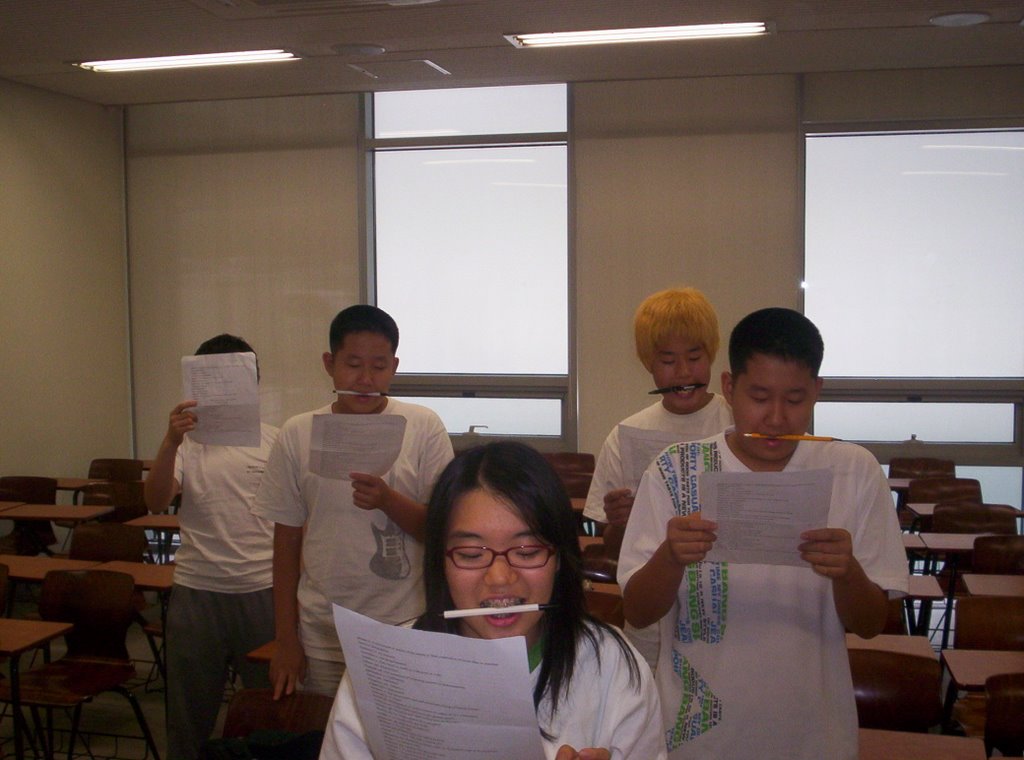
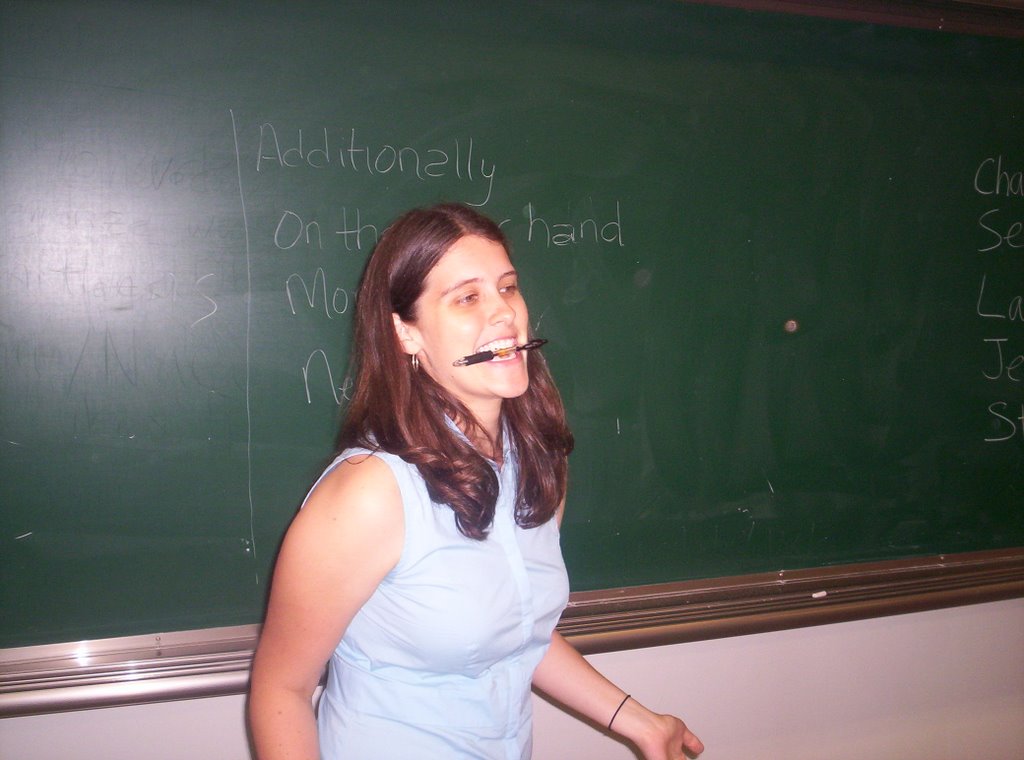
The pen-in-the-mouth speaking drill is a legendary staple of American debate training. Although some people think it's simply used to make you speak faster, it actually serves two other important purposes: First, it builds clarity, which was the purpose of teaching it to our students at the Ewha Workshop in Seoul. Second, it represents a partial (not complete) abandonment of dignity, because you look just a little silly when you do it. That was the purpose of me snapping a picture of Professor Kristen Looney leading the drill. The Seoul kids still have their dignity, though...


Colleagues in Korea

No beautiful Korean sites in this installment, but quite a few beautiful people...


Jason Jarvis, former outstanding debater from Emory University, now a lecturer and Assistant Dean at the KDI School of Public Policy and Management, and the dude who organized this whole KDA/Ewha event.


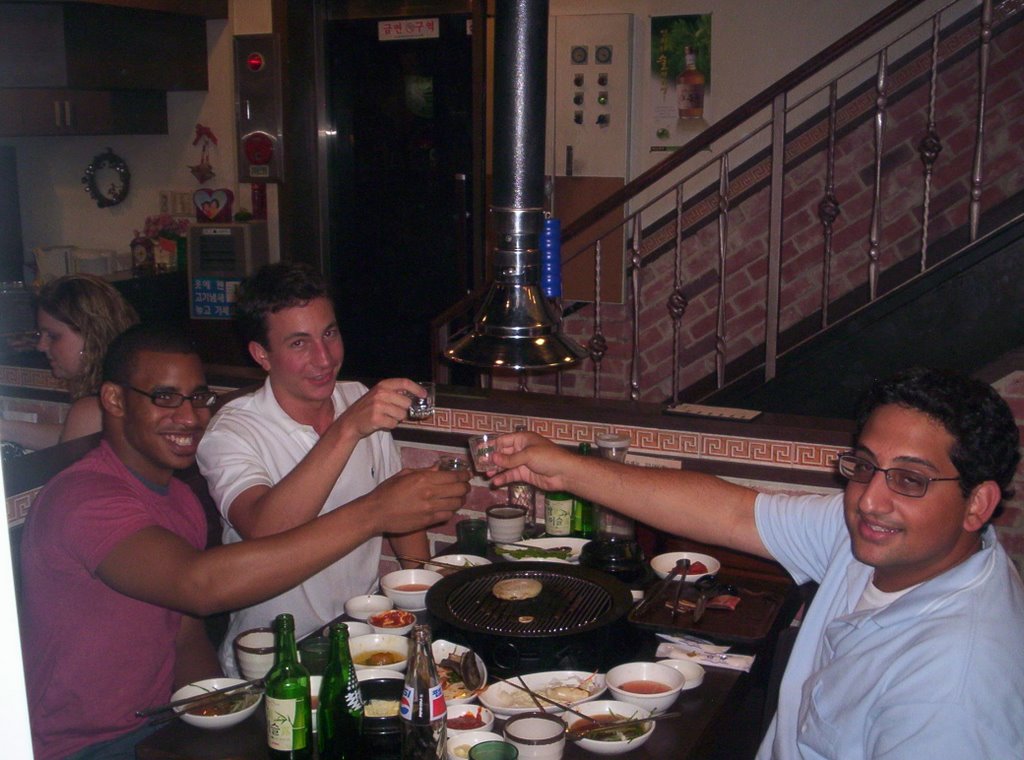
Devin "snappiest dresser in Korea" Murphy, two-time NDT first round bid recipient and quite sarcastic Stephen Chaudoin, and Vicas Kumar, whom, despite his protests to the contrary, I maintain had no drinking experience before coming to Seoul.


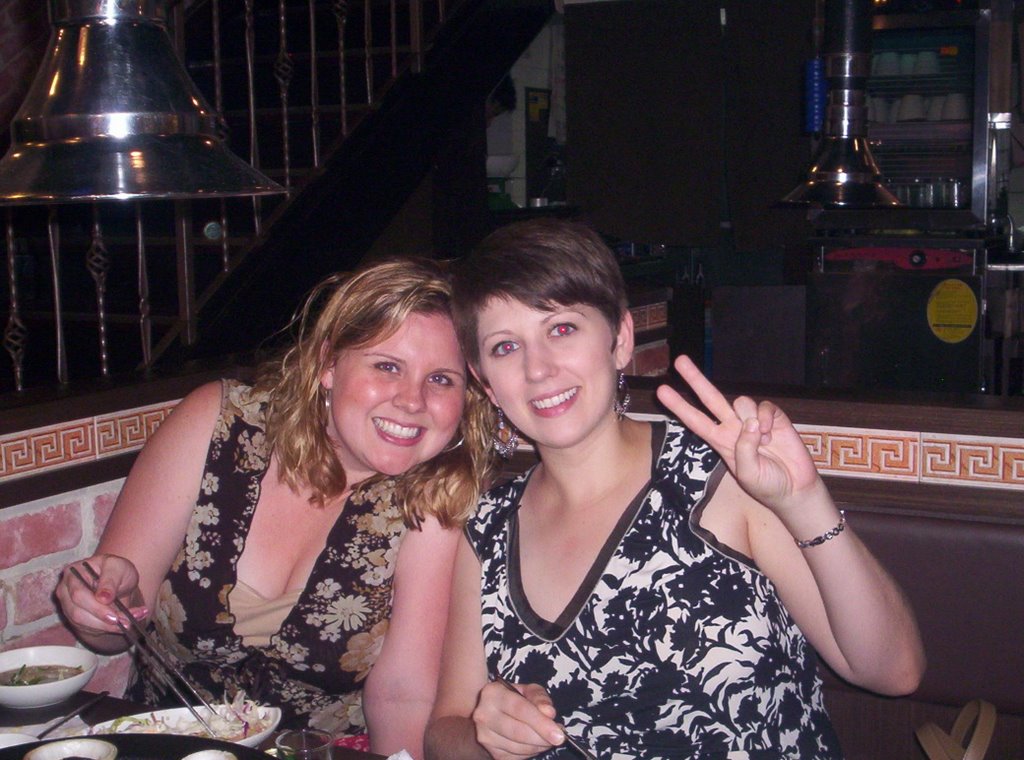
Jennifer Warfel and Christine Bradley...neither of whom I know well enough to make fun of, but I have a feeling that the truth will emerge sooner or later.


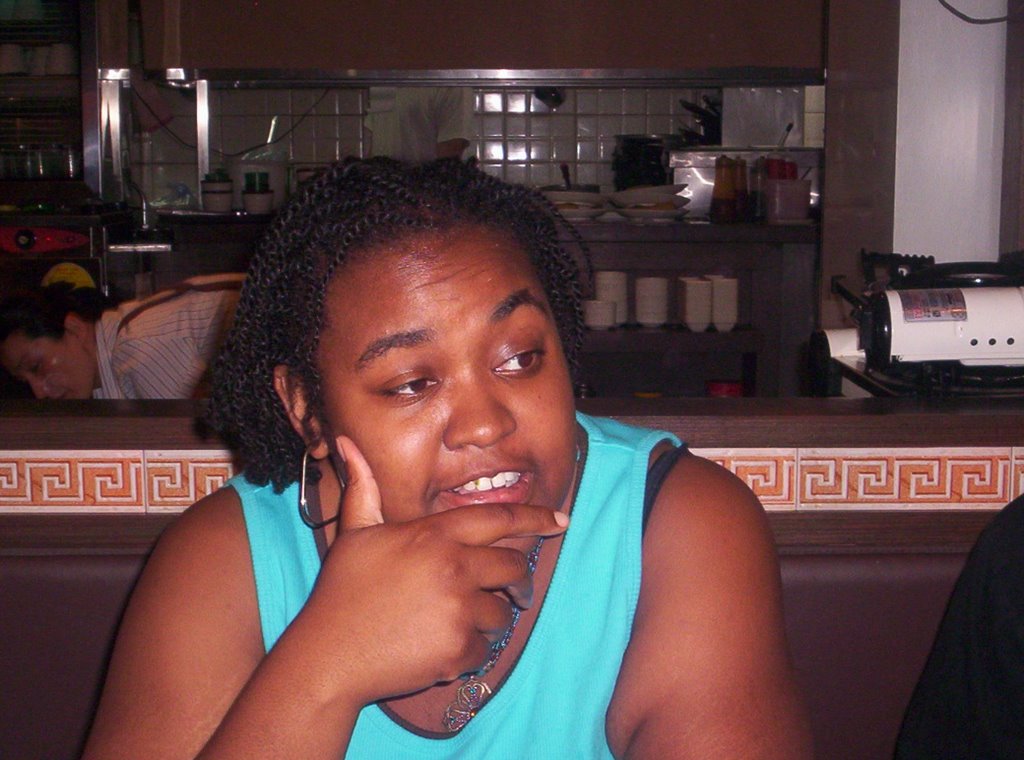
Brittney Cooper, contemplating something...perhaps the ongoing debate she's having with Elizabeth Jones about the history of Black Nationalism...perhaps the debate she had with Jarvis and me over Christian pedagogy and politics...perhaps just why she puts up with all of us.


Ah Young Kim, a debater for Ewha University. This is the smartest, nicest human being, and the best debater, in all of South Korea. She waited for all of us at the airport, found us food and supplies in the middle of the night, and worst of all, has to put up with Jarvis, which is only slightly more tolerable than being a secretary for Kim Jung Il. Everyone on staff here is vying to be president of the Ah Young Kim fan club, but I think I have an in.


Tonia Green. She is as kind and nice to the students here as she was scary and ruthless as a debater for Louisville. The best part is how she flashes an embarassed smile when they call her "Ms. Green."


Professor Meg Rithmire delivers an impromptu lecture on the intricacies of market foods in Seoul.


Kristen Looney, Steve Stein, Meg Rithmire, as Steve leads us all through the markets at night...


Kristen and Steve demonstrate their late-night debating skills for the citizens of Seoul. Resolved: We're here! No you fool, we're here!

The best is yet to come, including a photo of Kristen demonstrating pen-in-the-mouth speaking drills, and the Korean students following suit...So stay tuned, kiddies.

Tuesday, July 25, 2006

Some Pictures from Seoul: Part One: Barbecue!!!

Not too many "scenic" pictures (except of the beautiful people I'm working with), and thankfully none of me, but here is the first wave of pictures. I will be going on a DMZ tour before I leave, and I'll try to get more "touristy" photos in the meantime, but I hope these at least express what a great time I'm having and how lucky I am to be getting to know my companions and colleagues here.

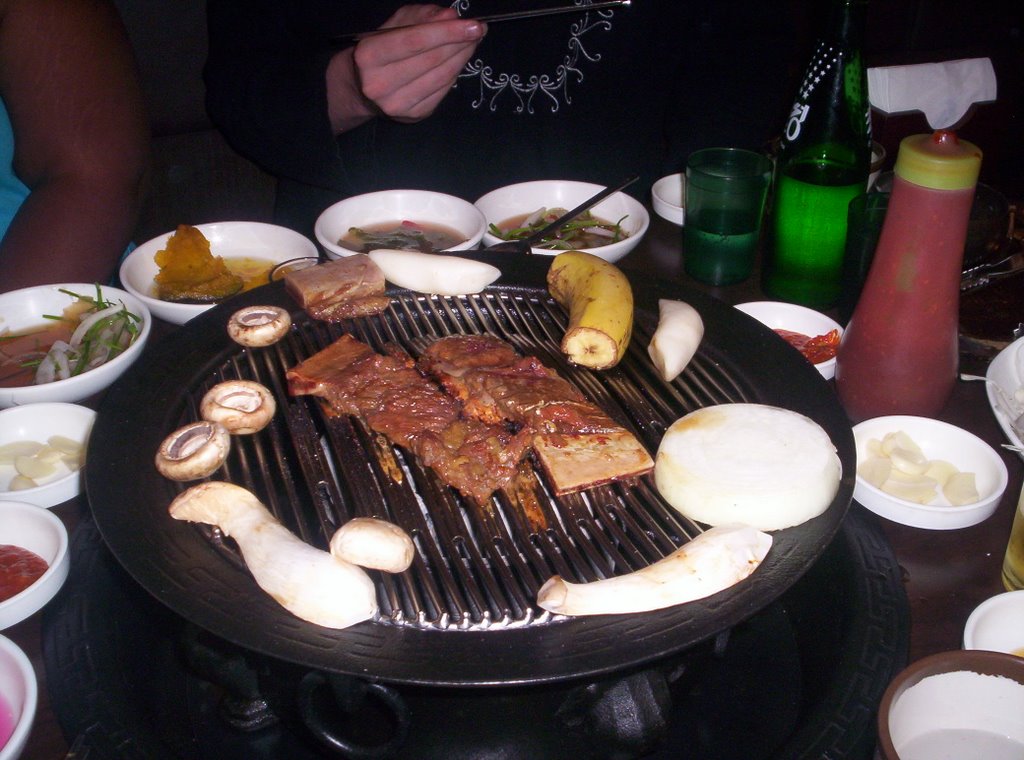
First up is an empty Korean barbecue grill...


...which was soon filled with the splendorous delights of meat, veggies, and even a banana...


More later, as I am running late for class...

Saturday, July 22, 2006

Greetings from Myeong-dong, Seoul

Well, I am here on my first full day working for the Korean Debate Association and the International Studies Department of Ewha Womans University. Today we are just kind of getting oriented to the time change and recovering from the long flight (mine was 11 hours, which isn't too bad, although I was too excited to sleep). Tonight we will have several meetings and then our sponsors are taking us out to dinner. I am still somewhat disoriented, and yesterday I was extremely so.

There are eleven American staff here. Most are PhD candidates at Emory University, but there are also two grads from U of Louisville and I am the lone "westerner" (the only American faculty member from west of the Mississippi). Melissa Wade of Emory is heading up the curriculum; as the "godmother" of contemporary American debate, she's a perfect person for the job. In addition to the American staff, there are two professors coming from Malaysia whom we haven't met yet.

We'll be teaching middle school and high school students from around Seoul. Debate is VERY new here; it's about four years old at the most. Everything we do and say will have a huge impression, since the kids we're teaching are really part of the first widespread generation of Korean students debating. They practice a style known as "All Asian Parliamentary" which isn't too different from American parliamentary debate. The Korean debate instructors and college debaters here are very familiar not only with U.S. debate practices, but even with the powerful schools and leagues. They ask questions about who's going to be good next season, etc., as if we were a sports franchise.

Although it's obviously the only way I ever could have taken this trip, I find it disturbing that English is assumed to be the "universal language" of debate. I might write more about that later. It just seems antithetical to the deliberative and democratizing purpose of debating. There does seem to be an unspoken "teach them to debate so they can learn English and be good workers in the new global economy." Yuck. I am hoping to teach them a little more than that while I'm here. We'll see.

Seoul is simply incredible. I know that many of you have been here, but for those who haven't, it's really impossible to describe. This picture is of Myeong-dong, which is exactly where we are.

There are people on the streets all hours of the day and night--it's like a 24 hour party, and the subway stations are really underground cities with tons of stores and business. One could live underground and really not know the difference. Food and everything else is really cheap. I ate a huge dinner last night for five bucks. There are internet cafes and karaeoke rooms everywhere too. And there are as many signs in English as in Korean.

I'll be getting back to the U.S. on August 7 and then heading immediately back to Laramie for the second half of the Wyoming Debate Cooperative, our two-week college debate workshop. Besides my family (whom I already miss very much) missing part of the cooperative is the only regret I have about taking this trip. So far, my time here has been almost surreal, and I am anxious to work with the students.

Tuesday, July 18, 2006

DELIBERATION OR BARBARISM

Speech delivered at the 6th Annual Wyoming Forensics Institute, July 18, 2006

I have given this speech the rather unoriginal and derivative title “Deliberation or Barbarism.” For many years various people in the debate community have used slogans such as “replacing weapons with words” and “violence begins when conversations end.” I propose tonight that we begin to take those slogans seriously. I believe that competitive debate serves a deliberative purpose, and that fostering a general commitment to rule-based deliberation is essential to our survival—whether our threats are apocalyptic or more nuanced. I don’t know if our species will be “wiped out” if we don’t start listening to each other, but I do believe that such listening, accompanied by a commitment to answering each other’s arguments, is a check against the barbarism and brutishness of those who profit from our failure to debate. And it isn’t hard to foresee a descent into complete barbarism, as competing factions abandon dialogue and submit to the lure of isolation and paranoia, interrupted by encounters based on degradation and abuse.

Over the past week we have been hearing tragic news about the conflict in the Middle East. Any armed conflict is tragic, but the antecedents of this current explosion have been brewing for a long time and they strike me as particularly tragic because of their impact on children. On one side, you have a movement of people striving for liberation, self-determination, and living space, but their leaders encourage them to strap bombs to their bodies—in some cases very young bodies—in order to go into public places and explode, taking countless others with them—including more children.

On the other side, you have a nation retaliating against these attacks by bombing particular targets, but because those targets are placed among civilians, more innocent people die, including more children. Ironically, many statistics suggest that these “extraneous” deaths of children outnumber the underage victims of suicide bombings.

If you have ever been a parent (and I know there are a couple of parents on staff), or even if you have ever had a little brother or sister, or a niece or a nephew, there is a certain primordial and ineffable awareness you get concerning the status of children, and especially infants. Their innocence does not merely render contemplation of their wartime deaths an unpleasant thought. Rather, it goes far deeper than that. I would submit that their sacrifice is so morally disgusting as to be a priori unacceptable, and that any strategic philosophy which admits of the death of children as a possibility, whether as a positive strategic tool or an "unfortunate" side effect, is a sign of the fundamental bankruptcy of that philosophy. It is never acceptable to kill children, either by intent or effect. Allowing infants and children to be either targets or unfortunate casualties exposes a flaw in the foundational concepts of your cause. Recruiting them for suicide missions in order to kill other children is a sign of a deep political sickness, not the legitimate desperation of the oppressed. Likewise, placing the death of children in the category of a regrettable side-effect may be more easily defended, but the result makes zero difference to the children who die or the parents who watch them die.

It should be obvious at this point that I believe the fundamental problem with the Israeli-Palestinian conflict is one of serious misleadership on both sides— a deep divide between the interests of the rulers and the interests of the "ruled."

Allow me to draw upon some lesser known history to offer an alternative to these cycles of violence. In 1994, in response to the kidnapping and killing of his 19 year-old son by Hamas, an Israeli named Yitzhak Frankenthal founded the Parents’ Circle, an organization consisting of both Israeli and Palestinian families who had lost loved ones in the conflict. Together, promoting mutual dialogue, they called upon all powerful parties “to promote reconciliation as the only way to reach true co-existence and peace.” Their stated method for promoting this reconciliation was to share with each other “personal and painful stories.”

Similarly, during the Bosnian war of 1992-1995, numerous groups emerged consisting of the mothers of soldiers conscripted to fight on all sides of the conflict. They marched hand in hand, together, although the Western media virtually ignored them.

The difference between on one side, armies who somewhat accidentally kill children (not particularly careful not to), along with their insurgent enemies who strap bombs to children and somewhat accidentally kill other children, and on the other side, parents marching together for the lives of their children, is a stark difference, characterized by a commitment to confront difficulty and difference, and above all, to listen to other people. It is a commitment that does not lend itself to easy answers or quick resolutions, because it recognizes the infinite and problematic nature of acknowledging other people—different people. It begins with a commitment to listen—not only to those with whom you already agree, but to those who seem completely different to you, even to the point of repugnance.

Jurgen Habermas points out that such seemingly unbridgeable differences are foundationally bridged by the very act of deliberative communication, since entering into that act is an implicit acknowledgement that the communicators know and respect the rules of communication. The moral principle in discourse ethics, he writes, “assumes that, because he/she is capable of thinking reasonably (cognitively), anyone who takes part in argumentation of any sort is in principle able to reach the same judgments on the acceptability of norms of action.”

How very different is this attitude from an obsession with security and isolation, a fear of otherness, a misapprehension that one can make oneself powerful enough to withstand and evade all mystery and difficulty. The unnamed character in Franz Kafka’s short story “The Burrow” is engaged in a perpetual monologue. Without the reality check provided by dialogical relations with other people, he continues to talk to himself, reassuring himself that he will eradicate the mysterious other, and that certainty, even certainty in despair, is preferable to not knowing:
I shall dig a wide and carefully constructed trench in the direction of the noise and not cease from digging until, independent of all theories, I find the real cause of the noise. Then I shall eradicate it, if that is within my power, and if it is not, at least I shall know the truth. The truth will bring me either peace or despair, but whether the one or the other, it will be beyond doubt or question.

As Tom Williams describes it:
the main character (some sort of burrowing animal) has dug a burrow with deep refuges, hidden entrances and a fortified center in order to protect itself and its possessions from real and imagined enemies. Even the secret escape route is a danger if an enemy accidentally discovers it and turns it into an entrance. The character doesn’t rest and is constantly thinking of possible dangers, of enemies and assaults on its burrow. Then there is the hissing, a constant, steady and never ceasing sound that spells danger. But through all the character’s efforts and paranoid speculation, nothing it can do will make that sound go away. At the end, the final words are, “But nothing had changed.”

Because the character is only talking to itself, each sentence reflects a new height of frenzy and completely rationalized irrationality; there is no dialogue to check the character’s manic paranoia, and even ultimate, depressed resignation. I have built all of these foolproof routes. But still I hear the threatening sound of others. Nothing has changed.

I would submit that the most radical point of the deliberative process does not concern any point at which I speak. It does not depend on the “radical-ness” of the content of my speech. Instead, the most radical point –if we take “radical” to mean “the point which possesses the greatest potential for systemic change” comes during my silence, because it is during that silence that I am listening to what others say.

It is not a silence without content. It is a silence whose content is an ethical commitment to listen—and not only to listen, but to record, that is, transcribe, the arguments of other people.

It is not an apolitical silence. It is a silence that contains an implicit political commitment to inclusion. Accompanied by the requirement that, in order to have a chance at “winning” the debate, I must concisely answer each point I hear, it is an implicit political commitment to the possibility of shared understanding.

It is not a silence that occurs within a context of communicative chaos. Rules are important, but it is equally important that the rules be co-created by the participants and not serve to preserve already-existing hierarchies. Methodology, science, and rationality are all important, but they must belong to the people rather than being imposed as a matter of metaphysical necessity from above.

There is a rather trite and ill-thought answer to the assertion that academic debate represents ritualized, deliberative ethics. That answer goes something like: “But the competitive nature of debate undermines its potential as a model of deliberative ethics.” An answer with equal brevity would be: But notice that the debaters that win the most are the ones who have the greatest understanding of what their opponents are actually saying. And another answer, equally profound: Notice that the debaters that win the most, and enjoy the greatest level of respect from their rivals, are those who accept both victory and defeat with grace, and who allow their love of the game to show forth above and beyond their obsessions with victory. Both of these answers are at least anecdotally true to me, and I believe they are tied into Habermas’s point that, in participating in any kind of open exchange, one implicitly, if not explicitly, acknowledges one’s valuing of the process of that exchange.

“But,” it is argued, “discourse itself can sometimes be violent, can sometimes be dehumanizing.” This is true. But after hearing it over and over, for years, by colleagues in the Communication discipline, as well as critical-minded debaters, I must frankly admit to having lost patience with those who invoke it against attempts to replace physical violence with dialogue. Of course we should attempt to make our language as inclusive and uplifting as possible. But—call me stubborn if you like—I would rather be called a dirty name than be shot. I’d rather be subject to verbal abuse than tortured. And I’d rather hear those dweebish military-minded debaters talking about counterforce, NMD and theater missile defense, than have a bomb fall on my house. If there is a link between violent discourse and violent materiality, then let’s debate about it.

These are the thoughts, and I admit they are a bit scattered, that I leave you with as I travel abroad to share in others’ argumentative and deliberative culture. You will stay here and make yourself infernally tired researching, giving practice speeches, perhaps engaging in the occasional water balloon fight…but think on this: The vast majority of your time, for all of you, will be spent in silence—listening to those who have been pre-assigned to disagree with you. I hope that some part of you can see this as more than a stimulating intellectual game. It’s a model for our fight against barbarism.

It’s good that you have to back up your opinions with research.

It’s good that you have to be quiet for a spell and faithfully record the speech of others.

It’s good that others will get the best of you, discursively and intellectually.

It’s good that you not only must follow rules of the game, but that you get to debate about those rules, what they mean, and how they are enforced.

These things are good, because we can picture how much better things would be if everyone had to work under that same set of rules. I don’t think it’s a terrible stretch of the imagination to assume that there would be far fewer young people killing other young people, often on the orders and promised rewards of old people.

So take these good things back with you. Be the model. Be the argument. Save the children. Stop the violence.

Debate.
Tuesday, July 11, 2006

heard any good jokes lately?

Here's one, courtesy of Bertell Ollman:

A capitalist is walking through his factory with a friend.

Friend asks, "What did you tell that man just now?"

"I told him to work faster", answers the capitalist.

"How much do you pay him?" asks the friend.

"Fifteen dollars a day" answers the capitalist.

"Where do you get the money to pay him?" asks the friend.

"I sell products", answers the capitalist.

"Who makes the products?" asks the friend.

"He does", answers the capitalist.

"How many products does he make in a day?" asks the friend.

"Fifty dollars worth", answers the capitalist.

"Then", concludes the friend, "Instead of you paying him, he pays you thirty-five dollars a day to tell him to work faster".

"Huh", and the capitalist quickly adds, "Well, I own the machines".

"How did you get the machines?" asks the friend.

"I sold products and bought them", answers the capitalist.

"And who made those products?" asks friend.

"Shut up! He might hear you".

Sunday, July 09, 2006

Rest in Peace, Frank Zeidler


http://news.yahoo.com/s/nm/20060708/pl_nm/zeidler_dc

Former Milwaukee Mayor Frank P. Zeidler, the last
Socialist to run a major U.S. city, has died, a
spokesman for a Milwaukee hospital said on Saturday.
Zeidler, 93, died on Friday of congestive heart
failure.
The son of a German Lutheran barber, Zeidler led
Milwaukee for three terms from 1948 to 1960 and also
ran for president as a Socialist in 1976.

My Mother the War

Natalie Merchant has been a solid lyricist for a long, long time. She wrote "My Mother the War" with John Lombardo and Michael Walsh. John Peel, the renouned DJ of cutting-edge music, called this one of the best songs of 1983. It's even more relevant today...

she borders the pavement
flanks avenues
the parades pass
white glove attended by
my mother the war
she'll raise a shaft
lift a banner
toss a rose
my mother the war
she knows every neighbor
chats at their doors
compare
econosize electric appliances
come share tea
and a seat by my
cradle with
my mother the war
forsaken vigil
three years each tour
hands of God enfold him
prayed mother of the war
haunt a doorway
beg a postman
is there word
for mother the war
5 black stars
in bitter defiance
she's spiting the corps
wet a brood
short league for combat
my mother the war
well aquainted
with sorrow
with grief
my mother the war
folded lace
carrion and
blood soaked robes
folded lace
carrion
blood soaked
shroud
my mother the war


Friday, July 07, 2006

What's depressing is that someone else wrote it and THEN she copied it...

By the way, it looks like Ann Coulter is in some trouble for plagiarism.

Hmm...I always found it odd that in all of Coulter's rants against Ward Churchill, she never mentioned the plagiarism charges...

Literal Power in a Metaphorical War?

John Burton, Socialist Equality Party candidate for United States Congress from the 29th District of California (I suspect some people will kill the messenger), has demonstrated his eloquence by summing up the entirety of the current epoch:
From any legitimate legal perspective, the “war on terror” is not a real “war”—a state of belligerency between sovereign nations—but a metaphorical war, like the “war on drugs,” for example, and does not constitutionally trigger the executive’s war powers. Moreover, its object is only a vague reference to a tactic, “terror,” rather than an identifiable organization or movement.

It's easy to see the syllogistic logic of Bush's argument: The war on terror will last for generations. It's a war, so it's a state of exception giving the executive virtually unlimited powers. Therefore, the executive has virtually unlimited powers for the next several generations.

John Yoo's legal theories reveal a similarly disturbing logic:
Cassel: If the President deems that he’s got to torture somebody, including by crushing the testicles of the person’s child, there is no law that can stop him?
Yoo: No treaty.
Cassel: Also no law by Congress. That is what you wrote in the August 2002 memo.
Yoo: I think it depends on why the President thinks he needs to do that.

Mark Levin, slightly-shy-of-genius, has complained that Congress and the Supreme Court are stripping the President of his war-making authority, ignoring the passage in the Constitution that gives Congress the authority to declare war.

Somehow I doubt compulsory logic or history lessons will solve any of this.

Sunday, June 25, 2006

This Man Needs Our Support!


Ross Smith is running for school board in Winston-Salem, North Carolina. I'm sure he'd appreciate some support, which you can give him through his web site

Saturday, June 24, 2006

The Unbearable Question of Resistance


Any time we begin with the question "what should we DO about the resistance," some kind of argument about what does and does not constitute legitimate resistance would probably be useful here.

Of course, the pragmatic argument against ANY legitimate resistance is that we're the United States, we have taken their country, and therefore they shouldn't resist. Questions about the legitimacy of the resistance might be found on Jason's list of discussions that won't answer the pragmatic urgency at hand. (Jason is "Catbert" on Net Benefits)

There's a classic, kind of common-sense argument that is commonly asked during questions about resistance: Would YOU use violence, take up arms, to resist a foreign takeover and consolodation of your country? Sure, that question has its problems, but it does cut to the core of the "subjectivity" of resistance.

Another possible argument is that they shouldn't resist because we've made their country better off. Regardless of the soundness of that argument, I'm sure most people could see why, at the very least, this argument has some problems in terms of shared reasonability, and moreover, it's in convincing them they will be better off that the U.S. would finally crush the resistance.

Of course there's the argument that foreigners and foreign-influenced resistance is illegitimate. That seems like the kind of choice the invaded country would make--to welcome others into their fight or not. But it's also legitimate to say that those who have gone to Iraq to fight us are an unsavory bunch of people. For the sake of argument, I'd be willing to concede the point and only concentrate on the moral justification of those who are fighting in the resistance because they want American soldiers and the American infrastructure out of their country.

And not only "are they justified in fighting," which we may perhaps never answer, but the more pragmatic "what tactics are they justified in using IF they are in any way justified in fighting?"

I wrote about this a long time ago, and I'm enough of a self-promoter to at least give up the links: Here and here.

My friend the political scientist Russell Fox replies to those posts here. While he largely takes me to school on some arguments, he also admits that
The ambiguity surrounding the identity of those claiming to fight on behalf of Iraq plays into Bush's "fly-trap" strategy, giving him a certain justificatory cover: as long as terrorism continues in Iraq, then he and those around him anc assert that we're dealing with terrorists, and by definition (well, his definition anyway) you can't "deliberate" with terrorists. Therefore, American troops must be the one's on the side of democracy, because we we're trying to give it to them, only we just haven't been able to get to the point where we can ask them in any legitimate if they like the way we are delivering it or not.

Friday, June 23, 2006

must give alternative?

It is a unique and, to me, rather uncharming feature of Realist thinking that its adherents can often legitimately collapse to the following argument:

Even if the war was publicly misjustified, and even if it has been executed incompetently, and even if we have alienated all of our allies and turned the world against us, and even if there's a chance that it will make everything worse, and even if the Bush administration would never listen to you anyway, you can't legitimately criticize the war, or decisions within the war, without explaining what we should now do to get out of a mess that you didn't create.
I disagree. Criticizing the process of a decision is absolutely legitimate. It is legitimate politically because it helps condition future political decisions, shapes debate, and inspires activism. It is ethically legitimate unless you believe, and believe strongly, that the ends always justify the means.

Demanding an alternative assumes a unitary purpose to political discussion and debate. The drive for such a unitary purpose makes possible all sorts of minor rhetorical tyranies, from the forced marginalization of process-based criticism, to the entrenchment of the kind of normativity Pierre Schlag, Richard Delgado and others indict in legal thinking (and actually a particularly bad kind of normativity even worse than legal, because it affects people across a wider spectrum and works its way into other categories of thinking). In my opinion, the most dangerous thing about this so-called normative thought is that it crowds out the space to assess, to describe, to investigate, the structures and contexts, the assumptions and symbolic patterns, that sustain the conditions that caused the problems.

Demanding an alternative also assumes a political and social universalism that simply doesn't exist. This is particularly frustrating to me because many times my criticism of political decisionmaking stems precisely from the way in which people are cut off from that decisionmaking--an exclusion primarily based on people's lack of resources and lack of powerful credentials. This results in a nonsensical argument: I say "the Bush Administration screwed up and didn't listen to anyone" and your answer is "Well, what would you have them do now?" If it weren't so sad, it would make a good joke.

Moreover, demanding an alternative seems to encode a kind of temporal particularism, a "temporal stasis" to borrow a term from Dungeons and Dragons. It assumes not only the universal social class described above, but a unitary moment from which to act. It says the choice of a political subject is always in the here and now, that urgency must always trump wisdom.

In short, the demand for an immediate alternative that could only be enacted by the very agents whom we've spent a great deal of time criticizing is a demand that comes from those who don't share our concerns. It's a demand from a different world, a world which, to steal from Ursula LeGuin, we have sort of "walked away from"--not to escape our responsibility to the suffering people in that world, but to reject the notion that we have to work exclusively within its conceptual and political rules.

Thursday, June 22, 2006

Clarifying the WMD Hype

Let's be very clear about something: The outdated, obsolete, and useless stockpiles of mustard or sarin gas recently found in Iraq, all manufactured before the 1991 gulf war (probably manufactured or procured from the United States and other western countries for use in the Iran-Iraq war), do not constitute the "Weapons of Mass Destruction" Bush and company listed as their primary reason to preemptively invade Iraq.

As Jane Harmon put it:
"There is nothing new here... Nothing in this report, classified or otherwise, contradicts the Duelfer Report, which assessed that we would find degraded pre-1991 weaponry in Iraq."

Even the Department of Defense and Fox News is taking the honest side of this question:
Mere hours after Sen. Rick Santorum (R-Pa.) announced breathlessly at a press conference that “we have found weapons of mass destruction in Iraq,” a FOX news reporter found out that Santorum was hyping a document that describes degraded, pre-1991 munitions already acknowledged and dismissed by the White House’s Iraq Survey Group.
...
Fox News’ Jim Angle contacted the Defense Department who quickly disavowed Santorum and Hoekstra’s claims. A Defense Department official told Angle flatly that the munitions hyped by Santorum and Hoekstra are “not the WMD’s for which this country went to war.”

Remember, Bush administration officials said Saddam was manufacturing WMDs, and that he was building a nuclear weapons program. They used false intelligence to claim that Iraq could attack western targets in 45 minutes. They claimed Saddam was in danger of sharing this updated, currently-manufactured technology with Al Qaeda. And they didn't just say "there's a pretty decent chance of this..." they spoke with utter confidence, using "we know beyond the shadow of a doubt" rhetoric.

It's simply pathetic to see apologists for the war claim that these old tin cans full of old materials constitute the very same WMD program that Bush and company said existed. It's very important to let everyone know that this is not the case. Tell your pro-war friends about this farce. Make sure they know that Fox News and the Department of Defense are on record as debunking the claim.

Regardless of current positions on the war, the fact that the Bush administration deployed false information to win both Congressional and public support for the war must never fade from our collective memory. It is an indictment of means that the ends will not and cannot justify. It is an indictment of the process of decisionmaking and public justification. Condemnation of the administration for that transgression can be shared by critical-minded people from those who demand immediate pullout to those who believe we should "stay the course" and everyone in between.

PS--CNN has debunked the claim that the intelligence community was responsible for the administration's misinformation on Iraqi WMD, and the Congressional Research Service has debunked the right wing claim that Congress had the same intelligence as the administration. The Bush administration claim of an active, potent WMD manufacturing and distribution scheme was the "central pillar" of their case for preemptive war, as CNN correspondent David Ensor accurately called it.

Tuesday, June 20, 2006

Tragedy

The two American soldiers who went missing in Iraq have been found dead. They are Army Pfc. Kristian Menchaca, 23, of Houston, and Army Pfc. Thomas Lowell Tucker, 25, of Madras, Oregon.

The occupation of Iraq was not in their interest, and their murders were not in the interest of the working people of Iraq. To say that they were unfortunate pawns in the quibbles and rituals of the powerful is not to take away their virtues as human beings or soldiers. Indeed, one longs for a world where their heroism and bravery could have been directed in the service of an unambiguously good cause. Such a world is far, far removed from the one that sent them to their tragic and unnecessary deaths.