Wednesday, January 26, 2011

Does Early Evidence Point to Success of ACA?

Early anecdotes, statistics, and honest assessments by small business observers all suggest that the conservative narrative against the Affordable Care Act is based more on what the conservative paradigm tells them the outcome should be--not what the outcome actually is.  Joan McCarter at Daily Kos has compiled some of the evidence:
There's more than just anecdotal evidence that the small business tax credit has spurred many more business to provide insurance to their employees. Last fall, the nonpartisan Kaiser Family Foundation reported a nine percent increase in businesses offering coverage, and the Los Angeles Times featured a story earlier this month reporting that "[m]ajor insurers around the country are reporting that a growing number of small businesses are signing up to give their workers health benefits, a sign of potential progress for the nation's battered healthcare system."
Even in a down economy with very high unemployment, being able to offer workers health benefits is a huge boon to small businesses. It is, incidentally, also good news for insurers, who've gained a lot of new customers. So the U.S. Chamber's zeal for repeal certainly isn't shared by the businesses they purport to represent, but apparently just those mega-corporations that actually comprise their membership. So the only conclusion that makes any sense is that the U.S. Chamber is operating on the basis of pure ideology, rather than what the average American business would want.
The insistence on repeating the conservative narrative sans facts has been politically and materially hazardous for organizations like the U.S. Chamber of Commerce. The Chamber has lost major corporations as members, as well as the cooperation of local chambers, because of its extremist ideology and unwillingness to objectively assess the economic effects of the legislation. In other words, people with genuine business and economic interests reject the conservative non-arguments for economic reasons. As Suzy Khimm writes in Mother Jones:
Angry about the lobbying behemoth's full-bore opposition to Democratic climate-change legislation, Apple, Nike, Johnson & Johnson, and a handful of other blue-chip corporations quit the Chamber. A few months later, about a dozen local Chambers of Commerce publicly broke away from the group, arguing that the national organization had swung too far to the right and no longer represented its members' views. Now, some of the same questions are beginning to surface over the Chamber's hard-line stance on health care. Since the new Congress has begun, the group has come out swinging against "Obamacare," boosting conservative claims that reform is killing businesses and the economy. "It's time to go back to the drawing board," said Tom Donohue, the Chamber's chief executive officer, at his annual address last week. "The Chamber was a leader in the fight against this particular bill—and thus we support legislation in the House to repeal it." Could another civil war erupt within the Chamber over health care reform? Given that full repeal isn't politically feasible any time soon, a repeat of 2009's defections seems unlikely, and the Chamber itself has begun adopting a more targeted approach to submarining reform. But when it comes to the Chamber's constituency outside the beltway, some local branches say they don't agree with the national Chamber's stance on repeal.
Neither the Kos nor the Mother Jones pieces weigh the evidence against the criticisms of the left (and remember--more people believe the ACA doesn't go far enough than believe it goes too far). We know the legislation doesn't go far enough fast enough, and that single payer would have been more fiscally responsible and successful in terms of the policy objective of universal coverage. But the news of the ACA's early success doesn't undermine those arguments, and it should serve to make the public suspicious of arguments from both the right and the center against single payer. If the Chamber, and its ideological constituency, can't get it right on center-right reform, there's really no reason to trust their dismissals of more progressive reform, should the opportunity to make that case arise in the near future (importantly: Many important groups never stopped arguing for it, and those groups simultaneously oppose repeal of the ACA).

Painful Becktal Itch

As Glenn Beck pathetically and enthymematically invites violence on yet another figure of the left, and Fox officials recite their usual denials and disclaimers, it occurred to me that no conservative I know personally (and having lived in Utah, Wyoming and California I know more than enough) will defend Beck in a conversation.  They won't proactively call him out, though.  They all say he's bad for their side, but they're either lying about their disposition towards him, or they're weak-willed in terms of trying to raise the level of conservative discourse.

So help me out, dear reader: Aside from a couple of right wing mediawatch sites, are any articulate conservatives--and/or conservatives you know personally--standing up for this death clown? 

Sunday, January 23, 2011

um yeah, about that alliance thing...

Concerning this so-called "progressive-libertarian alliance" ... anyone remember the story of "The Scorpion and the Frog" ? Why does that keep popping into my mind when I hear Nader reassuring us that Ron Paul, et al, only want to help us working folks?

Wednesday, January 19, 2011

When Bourgeois-Liberal Rhetoric Backfires

I had a feeling that the Democratic strategy to call on GOP members of Congress to give up their federal health insurance would backfire. And it has.
Looks like we've got another House GOPer who has decided to forgo the health insurance members of Congress enjoy -- because he says members of Congress should not support laws they don't want applied to themselves. [...] Dems, of course, have been demanding Republicans give up their insurance, in order to tar GOPers who favor repeal with the hypocrisy charge. But at this point, it should be noted that a surprising amount of House Republicans have now endorsed the idea by agreeing to do it themselves. Among them are Bobby Shilling, Mike Kelly, Joe Walsh, Daniel Webster, Sandy Adams, Frank Guinta, David McKinley, and Bill Johnson.
The reason they can do this is simple: Since most of these representatives range from upper-middle class to extremely wealthy, they can afford private health insurance. The rhetorical strategy of holding them to consistency might have worked if, say, the stakes were donning a uniform to fight in Iraq and Afghanistan, but the Democrats could hardly make such a demand when the vast majority of them have been complicit in Obama's continued occupation of those countries. But since the best options for providing affordable care to poor people were kicked off the table before the health care reform debate even began, and because it was the Democrats who were responsible for those manuevers, the center-right has nowhere to stand when their rich GOP colleagues call their bluff on federal employees' health insurance.

So as the House comes closer to finalizing their symbolic repeal vote, and a few (very few) principled Democrats remind the public of the tiny bits of common sense that the Act actually contains, the GOP has found another opportunity to strengthen their hand, without fear of genuine political opposition or reprisal. This is what happens when the only check against wealthy people without a conscience is wealthy people with an occasional conscience.

Friday, January 07, 2011

Sometimes when I get a message on my fax machine, I wonder: "Did little demons get inside and type it?"

Bill O'Reilly claims science can't explain the tides.
Apparently, Bill O’Reilly has never heard of the moon. In a debate Tuesday with Dave Silverman, head of the American Atheist group behind this, the Fox host tried to prove the existence of God by citing the unknowable mysteries of the tides. “I’ll tell you why [religion is] not a scam, in my opinion,” he told Silverman. “Tide goes in, tide goes out. Never a miscommunication. You can’t explain that. You can’t explain why the tide goes in.”

Silverman looked stunned. “Tide goes in, tide goes out?” he stuttered. O’Reilly pressed on. “The water, the tide—it comes in and it goes out. It always goes in, then it goes out. … You can’t explain that. You can’t explain it.”
I am pretty sure Jews, Christians, Muslims, Hindus, Shintoists, Rastafarians, Pastafarians, Zoroastrians, Buddhists, Confucians, and Taoists can all agree that Bill O'Reilly is as stupid as a sack of nails.  Only the Moonies are likely to dissent.

yeah but

Yes, conservatives--yes, we do have some of the best health care in the world--& nearly a quarter of us can't afford to use it, tens of millions more would be financially wiped out if a family member got sick, & health care facilities are laying off workers because more & more people can't afford care. In this context, it's absurd to speak of repealing modest reforms OR being satisfied w/ said reforms.

Obvious to most people, but worth inscribing just to remind ourselves in a few years that we were right about this.
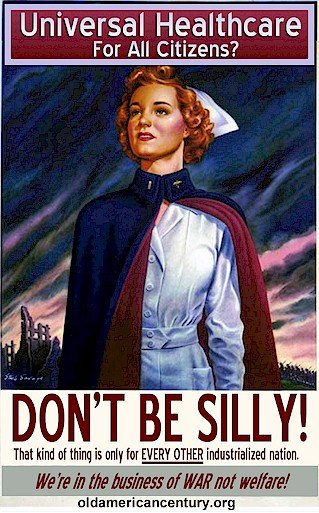
Anyone else think that nurse is kinda hot?


Friday, December 31, 2010

WikiLeaks, Secrecy States and the Call for Blood

Leave it to veteran pacifist David McReynolds to point out the pathology of the right's latest calls for violence. David has been emailing a group including me almost daily pointing out the ways in which right wing hawks' current call for blood is the culmination of the the violent secrecy state. At a time when almost 20% of Americans are unemployed, underemployed, and in general, employment-challenged; at a time when we are fighting two illegal wars and watching our domestic infrastructure crumble and social programs dry up because of it; after we've suffered the worst oceanic oil disaster in human history; what does the right do? Call for the assassination and/or execution of people leaking and disseminating classified documents. Rather than being outraged at the content of the documents, conservatives want to send one of our James Bonds out to assassinate the founder of the web page releasing that information.

This isn't just a couple of over-exposed loonies, not the hideous hybrid created by the joining of Ann Coulter and Michael Savage, not just Alan Dershowitz writing another book. The calls for assassination are coming out of the conservative woodwork. It's crass opportunism rather than sound policy analysis, of course, but it provides further proof that, as conservatism circles the drain, its adherents will go to ever greater lengths to demonstrate their verility and marketability. Nor should we forget that what passes for analysis from the conservative side is mostly provided by politicians who are receiving bonifide paychecks from Fox News.

As I said on Wednesday's podcast, Bradley Manning is the whipping boy for the secrecy state. Even if the "limited" solitary confinement of Manning is not torture, it's not clear what the policy purpose of such confinement is if it's _not_ punitive. And, of course, if it is punitive, it is unconstitutional and even violates the UCMJ's Article 13: "No person, while being held for trial, may be subjected to punishment or penalty other than arrest or confinement upon the charges pending against him, nor shall the arrest or confinement imposed upon him be any more rigorous than the circumstances required to insure his presence..."

Unnecessary, unlawful confinement and drain-circling political figures trying to make their name, or keep their name, by calling for murder: These are the whines of a dying military-industrial complex and spokespersons desperate to make a few more bucks before the collapse of empire. We need to keep articulating the alternatives in 2011.

The Real Dexter

Not sure about this other "Dexter" everybody's talking about. The real Dexter has a massive laboratory and can time travel and stuff. Much cooler than being a (yawn) serial killer.

Tuesday, December 28, 2010

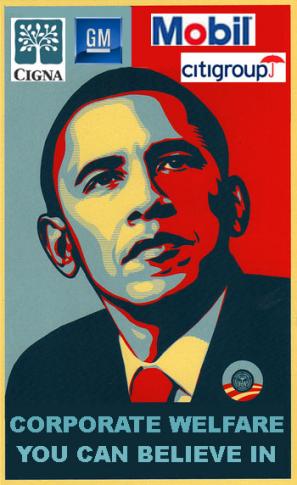
image management

Just like Bill Clinton gutted welfare better than any Republican could, President Obama has overseen the dismantling of major components of New Deal and Great Society policies--in the midst of an economic crisis the likes of which haven't been seen in half a century. And to think the right wing subintellosphere still calls him a socialist...
One fact says a great deal about the reality of Obama’s policies: the reduction in the estate tax included in his tax-cut deal with the Republicans brings the tax on inherited wealth to its lowest level since 1931, prior to Roosevelt’s coming to power. Roosevelt during World War II pushed for the tax rate on the highest income tax bracket to be raised to 91 percent and imposed a cap on executive salaries.

Obama’s measures will provide an estimated $70 billion a year in tax breaks for the rich and hand over an additional $23 billion in estate tax cuts to 6,600 families.
The shift on Obama exemplifies the ceaseless efforts of the corporate-owned and controlled media to artificially create political realities by means of image making. Obama’s election was largely the result of a media marketing operation, backed and financed by sections of the ruling class that saw the need for a change in image and personnel after the foreign policy disasters of the Bush years and in the face of public hatred for Bush and the Republicans.
Now, the media is seeking to repackage and repair the badly discredited Obama administration. Why? Because it is dutifully doing the bidding of the financial aristocracy.

does yours?

Inspired by a random note by a friend...

My butt shines like gold
There's too much of it to hold
It smells like a pretty flower
Although I never shower
It jangles when I walk
I wish that it could talk
They'll say when I am old
That my butt shone like gold
--MJS 12-28-10

Monday, December 27, 2010

start from anywhere post 2

The WikiLeaks affair presupposes "state secrets." So what is the state, and on what grounds may it keep secrets?

Thursday, December 23, 2010

DADT and Economic Justice

Sometimes acts of justice move in the same normative direction even though they may not be fully consistent with one another.  Activists negotiate their movement around these acts in different ways.  While millions of people are celebrating the impending demise of the ban on openly GLBT military personnel, a few organizations, and many individuals, have questioned the appropriateness of progressives celebrating a policy which, foundationally, is a victory for the military-industrial complex, a route for more smoothely escorting people into the imperialist death machine.

While it is important to note that the public justification for lifting the ban drips with the rhetoric of imperialism, there's not a lot of new information to discover there.  The U.S. military is simultaneously the oppressive arm of multinational capital, and home to millions of working class people, many of whom are economically dependant on the military and, of those, many who discover, too late in some instances, that much of the solidarity, honor, and valor they may initially have sought in their jobs has been hijacked by the imperialist-mercenary role of U.S. forces. 

One terse dismissal of the DADT victory came from Queers for Economic Justice, who seamlessly tie the struggle for economic justice to the overall struggle against militarism:
QEJ believes military service is not economic justice, and it is immoral that the military is the nation’s de facto jobs program for poor and working-class people. And since QEJ organizes LGBTQ homeless people in New York City, we wanted to remind the LGBT community and progressive anti-war allies that militarism and war profiteering do not serve the interests of LGBT people.
When I posted QEJ's statement on the Shared Sacrifice FB fan page, one reader responded that it was shameful QEJ seemed incapable of distinguishing between doing one good thing and solving every systemic problem.   I agree, but I'm trying to understand their argument better. They needed to better articulate how, precisely, this is a setback or a distraction--the only two warrants, as I see it, for their conclusion. It is true that, as presently constructed, "military service is not economic justice." But neither are most jobs where we're demanding an end to discrimination. What I do agree with, vehemently, is the need to prioritize the struggle for economic justice.

Last Saturday, Jason & Annette & I had a good discussion on the Shared Sacrifice Weekend podcast about the tension between equal rights within existing institutions, and the true argument that this is all just more human beings being thrown into the grinder. Several arguments emerged, of which the following are the general types, and I am not necessarily endorsing any of them as I list them: (1) Gays already serve, always have, so kind of a "non-unique, only a risk you increase people's dignity" argument. (2) Equal opportunity: Serving in the military is often a pathway to getting good jobs, paying for education, and other benefits. Saying "f--- the war machine!" doesn't answer back the equality argument, it just makes you sound like a hippie who has nothing to offer the working class. (3) The "it's not militarism itself, it's the bourgeois fat cats who start the illegal wars" argument. Essentially: the military can be used for good ends such as fighting the Nazis, disaster response, space exploration, anything good requiring major amounts of discipline, comaradery and collective will. Don't knock the military--reform society and end the corporate colonization of all aspects of American life, and institutions will invariably change for the better. (4) Don't insult people in the military by reducing the entirety of their existence and their values to "dying for oil" or whatever.


Personally I see no more contradiction fighting imperialism while promoting equality in the military, than I see fighting wage slavery while promoting equality in the workplace.  In a sense, these are inconsistent, because the social and material conditions under which we live are themselves inconsistent.  But like I said at the outset, they move in the same normative direction.  Controversial, even uncomfortable conversations like those sparked by QEJ, help us forge that normative space, important in the long view.  And while we argue, we can fight for common goals (think ENDA, since even after DADT is repealed, bosses all over the country will still be able to fire workers for being gay). 

Sunday, December 05, 2010

start from anywhere post 1

A paradoxical, consistent historical phenomenon: When the number of poor in a society increases, so do the open, blatant attacks on the poor (it's their own fault, they shouldn't be allowed to vote, let's criminalize poverty, etc.).  As socioeconomic forces increase poverty, the rhetoric reducing poverty to a moral choice escalates.